
Description
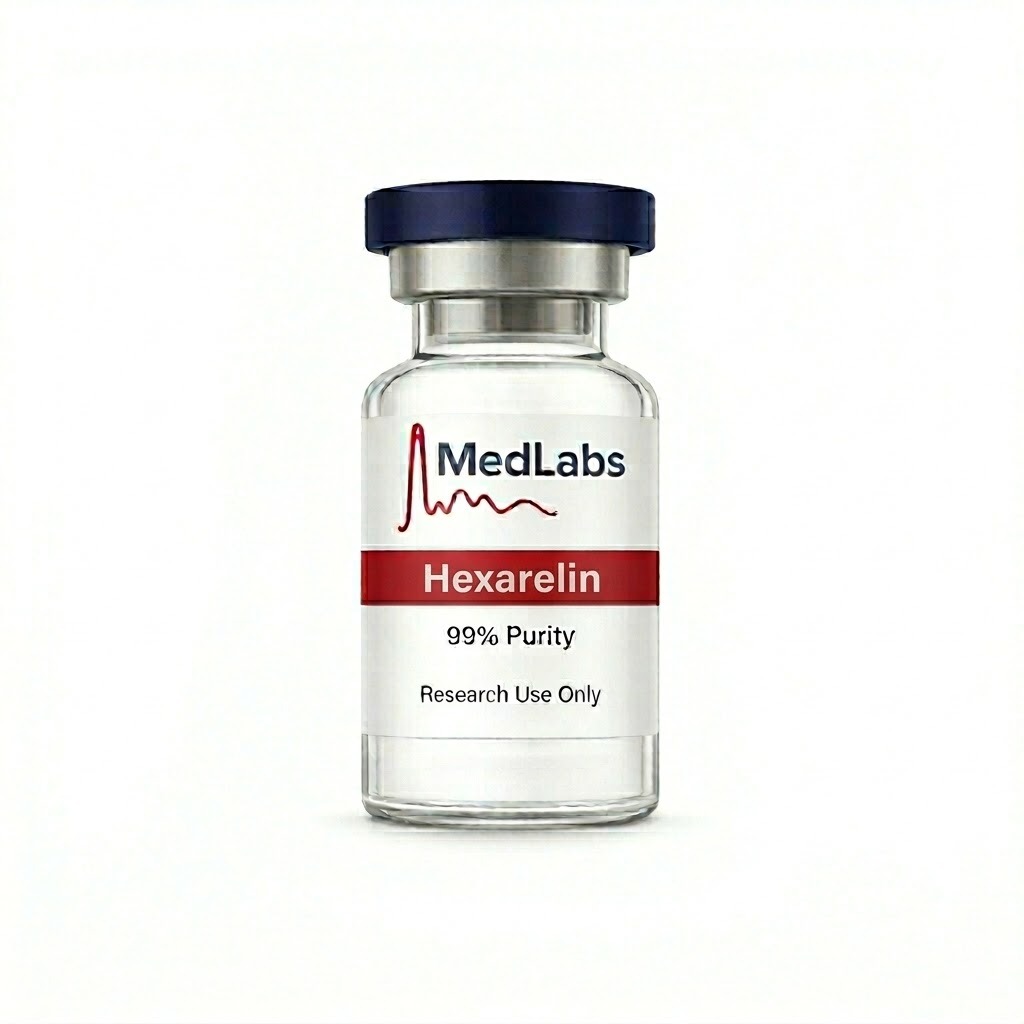
Hexarelin Peptide | Synthetic GHRP Research Compound
Quick Specifications
Hexarelin peptide
| Parameter | Value |
|---|---|
| Common Name | Hexarelin (Examorelin) |
| Synonyms | Examorelin, GHRP-His-D2MeTrp-Ala-Trp-D-Phe-Lys-NH₂ |
| CAS Number | 140703-51-1 |
| Molecular Formula | C₄₇H₅₈N₁₂O₆ |
| Molecular Weight | 887.05 g/mol |
| Purity | ≥98% (by HPLC) |
| Appearance | White to off-white lyophilised powder |
| Storage | –20°C or below, desiccated, protected from light |
| Solubility | Soluble in sterile water and buffered aqueous solutions |
| Pack Size | 2 mg / 5 mg (research vials) |
Overview
Hexarelin peptide is a synthetic, six-amino-acid growth hormone-releasing peptide (GHRP) developed more than 25 years ago as part of a broader class of compounds designed to investigate ghrelin receptor signalling. Also designated examorelin, it is structurally related to GHRP-6 and is classified within the growth hormone secretagogue (GHS) peptide family. Hexarelin is among the most potent synthetic GHS-R1a agonists characterised in preclinical literature, making it a widely used molecular tool for studying hypothalamic–pituitary signalling and growth hormone secretion dynamics.
In preclinical research, hexarelin is valued for its ability to activate growth hormone secretagogue receptors (GHS-Rs) — specifically GHSR-1a — with high affinity. This receptor is expressed across the pituitary gland, hypothalamus, cardiovascular tissue, and peripheral nervous system, giving hexarelin broad utility as a research probe across neuroendocrine and cardiometabolic study areas.
Scientific literature indexed on PubMed documents hexarelin’s application across growth hormone secretion studies, cardiovascular function models, muscle tissue preservation research, and body composition investigations. Peer-reviewed research suggests that hexarelin’s receptor activation profile differs meaningfully from endogenous GHRH, activating distinct intracellular pathways and demonstrating additive effects when combined with GHRH in experimental settings.
MedLabs Peptides supplies research-grade hexarelin peptide at verified purity for laboratory and preclinical use exclusively. This product is not approved for human or veterinary administration.
Mechanism of Action
GHSR-1a Receptor Binding and Intracellular Signalling
Hexarelin exerts its primary biological activity by mimicking the endogenous hormone ghrelin — a 28-amino-acid acylated peptide — at the growth hormone secretagogue receptor subtype 1a (GHSR-1a). This G-protein-coupled receptor is expressed in the anterior pituitary, hypothalamus, central nervous system, and a range of peripheral tissues, including cardiac muscle. Hexarelin’s binding to GHSR-1a initiates conformational changes in the receptor that activate downstream G-protein signalling cascades.
The principal intracellular pathway involves Gαq-mediated activation of phospholipase C (PLC), generating inositol trisphosphate (IP₃) and diacylglycerol (DAG). IP₃ triggers calcium mobilisation from intracellular stores, while DAG activates protein kinase C (PKC). Together, these second messengers amplify the signalling cascade in pituitary somatotroph cells, facilitating growth hormone (GH) release. Additionally, cAMP-mediated Gαs pathways may contribute to hexarelin’s intracellular signalling profile, though the Gαq/PKC pathway appears to be the primary mechanistic route.
Importantly, peer-reviewed research indicates that hexarelin activates GH release via a mechanism distinct from that of growth hormone-releasing hormone (GHRH), which acts through the GHRH receptor on pituitary somatotrophs. Studies published in peer-reviewed journals suggest that GHRP-class peptides — including hexarelin — and GHRH may act on two separate receptor sites, and that when combined, their effects on GH secretion may be additive. This mechanistic independence makes hexarelin particularly valuable in research designs that require GHRH-independent GHSR-1a stimulation.
Beyond growth hormone signalling, hexarelin’s GHSR-1a activation in hypothalamic circuits has been associated in preclinical models with modulation of appetite-regulating neuropeptides, including upregulation of Neuropeptide Y (NPY) and Agouti-related peptide (AgRP), and potential suppression of alpha-melanocyte-stimulating hormone (α-MSH). These pathways are implicated in energy balance and feeding behaviour research. Additionally, GHSR-1a expression in the mesolimbic reward system suggests hexarelin may influence reward-driven feeding behaviour through cAMP-mediated mechanisms — an area of ongoing preclinical investigation.
Researchers should also note that prolonged hexarelin exposure has been associated with transient receptor desensitisation lasting days to weeks in some animal models, a finding relevant to chronic dosing study designs. Furthermore, hexarelin has been reported to non-selectively stimulate other pituitary hormones — including adrenocorticotropic hormone (ACTH) and prolactin — which represents a recognised limitation in studies requiring high GH-pathway specificity.
Research Applications
- GHSR-1a receptor activation studies — Characterising receptor binding kinetics, functional agonism, and downstream G-protein signalling using hexarelin as a reference GHS ligand
- Growth hormone secretion models — Dose–response investigations of hexarelin-induced GH release in primary pituitary cell cultures and animal models across developmental stages
- GHRH and hexarelin combinatorial research — Studies examining additive or synergistic effects of hexarelin and GHRH on somatotroph GH output in both GHRH-sensitive and GHRH-insensitive cell lines
- Cardiovascular function research — Preclinical studies investigating hexarelin’s effects on cardiac contractility, left ventricular ejection fraction, ischaemia-reperfusion injury, and cardiomyocyte survival
- Body composition and fat mass models — Animal model studies examining the relationship between GHSR-1a activation, peak GH release, and fat mass parameters
- Muscle tissue preservation studies — Preclinical cachexia and catabolic models evaluating hexarelin’s potential effects on skeletal muscle mass, calcium homeostasis, and strength parameters
- Appetite and feeding behaviour research — Hypothalamic circuit studies examining hexarelin’s modulation of orexigenic neuropeptide expression and mesolimbic reward pathway activity
- Receptor desensitisation studies — Characterisation of GHSR-1a downregulation kinetics following acute versus chronic hexarelin administration in in vivo models
- Comparative GHRP pharmacology — Head-to-head receptor activation and GH secretion comparisons between hexarelin, GHRP-6, GHRP-2, and Ipamorelin
Common Research Questions
What is hexarelin peptide used for in research?
In preclinical research, hexarelin peptide is primarily used as a high-potency GHSR-1a agonist to study growth hormone secretagogue receptor signalling, GH secretion dynamics, and hypothalamic–pituitary axis regulation. It is also applied in cardiovascular research models, body composition studies, and muscle-sparing investigations under catabolic conditions. Scientific literature indexed on PubMed documents hexarelin’s utility across these research domains in both in vitro and in vivo experimental settings.
Is hexarelin relevant to muscle growth research models?
Preclinical studies have investigated hexarelin in the context of skeletal muscle preservation rather than anabolic growth per se. Several experimental models using catabolic conditions — including cisplatin-induced cachexia — have reported that hexarelin exposure was associated with attenuated reductions in muscle mass and muscle strength in rodent models. Peer-reviewed research suggests this may relate to hexarelin’s modulation of calcium homeostasis in skeletal muscle and its GH-secretagogue activity. These findings are specific to preclinical animal models and do not constitute evidence of therapeutic efficacy.
Does hexarelin affect fat metabolism in preclinical models?
Research examining body composition and hexarelin exposure has reported a negative correlation between fat mass and peak GH release following hexarelin administration in animal models. Studies suggest that higher fat mass may be associated with attenuated GH secretory responses to hexarelin. Whether this represents a direct hexarelin–fat metabolism interaction or an indirect effect mediated through GH-pathway modulation remains an area of ongoing preclinical investigation. Researchers asking what the best peptide for belly fat research models is should note that hexarelin is not a validated fat-mobilising agent — its fat-related research utility lies in understanding GH-axis and adiposity interactions.
Does hexarelin affect sleep-related signalling pathways?
GHSR-1a receptors are expressed in brain regions implicated in sleep–wake regulation, including the hypothalamus and brainstem. Preclinical literature has noted ghrelin-mimetic peptides’ interaction with neuroendocrine pathways relevant to sleep physiology. However, hexarelin-specific sleep research remains limited in the published literature. Researchers investigating sleep-relevant GHSR-1a signalling should note that hexarelin’s broad receptor distribution across CNS tissues may produce off-target signalling relevant to these pathways in animal models.
Can hexarelin be administered via alternative routes in research?
Preclinical pharmacokinetic literature indicates that hexarelin is predominantly studied via subcutaneous or intravenous administration in animal models. Oral bioavailability is limited due to peptide degradation in the gastrointestinal environment, as is typical for peptides in this molecular weight range. Researchers exploring oral GHSR-1a activation may instead reference non-peptide GHS compounds in comparative study designs. All administration route decisions should be determined by institutional protocols and the specific research design requirements.
What are the documented hexarelin side effects and limitations in animal studies?
Preclinical literature identifies several notable limitations of hexarelin in research models. These include non-selective stimulation of pituitary hormones beyond GH — specifically ACTH and prolactin — which may confound studies requiring isolated GH-pathway analysis. Transient GHSR-1a desensitisation following repeated or prolonged hexarelin exposure is also documented, with recovery periods lasting days to weeks in some animal models. Researchers designing chronic dosing studies should incorporate appropriate wash-out periods and receptor sensitivity controls.
How does hexarelin compare to GHRP-6 and other growth hormone secretagogues?
Hexarelin is structurally related to GHRP-6 and shares the same primary receptor target (GHSR-1a). However, peer-reviewed studies suggest hexarelin demonstrates higher GH-releasing potency than GHRP-6 in several preclinical models, while also showing a broader stimulatory profile that includes ACTH and prolactin. Ipamorelin, by contrast, is generally reported in the literature to exhibit greater selectivity for GH-pathway stimulation with reduced off-target pituitary hormone effects. The choice between these compounds in research settings depends on the specificity requirements and the model system used. MedLabs Peptides supplies GHRP-6, GHRP-2, Ipamorelin, and Hexarelin to support comparative GHS pharmacology studies.
Handling & Storage
- Dry conditions — Hexarelin is a synthetic peptide susceptible to moisture uptake; handle and weigh under dry laboratory conditions
- Reconstitution — Dissolve in sterile water or bacteriostatic water; gentle swirling is recommended — do not vortex or shake vigorously, as mechanical agitation may compromise peptide integrity
- Working concentration — Prepare stock solutions appropriate to your assay system; consult relevant literature for concentration ranges used in comparable preclinical models
- Filter sterilisation — For in vivo research applications, filter through a 0.22 µm sterile membrane immediately before use
- Aliquoting — Divide reconstituted stock into single-use aliquots before freezing to eliminate the need for repeated freeze–thaw cycles
- Post-reconstitution storage — Store at 2–8°C if using within 7–14 days; store at –20°C for extended retention; do not refreeze thawed aliquots
- Light sensitivity — Protect lyophilised powder and reconstituted solution from UV and direct light at all times
- Temperature — Do not expose to temperatures above 25°C for extended durations; lyophilised vials are stable at –20°C within the manufacturer-specified shelf life
- Pre-use inspection — Inspect reconstituted solution for visible particulates, turbidity, or discolouration before introducing to biological assay systems
Safety & Compliance
⚠️ FOR RESEARCH USE ONLY
Hexarelin peptide supplied by MedLabs Peptides is intended exclusively for in vitro and preclinical in vivo laboratory research. It is not approved, licensed, or intended for human consumption, veterinary use, therapeutic application, or diagnostic purposes of any kind.
- This product has not been evaluated by the MHRA, FDA, EMA, or any equivalent regulatory authority for safety or efficacy in human or veterinary use
- No therapeutic, performance, health, or clinical claims are made or implied by MedLabs Peptides
- All research use must comply with applicable institutional biosafety protocols, national regulations, and international guidelines governing peptide research and animal experimentation
- The purchasing institution and the individual researchers bear full responsibility for ethical approvals, regulatory compliance, and appropriate experimental use
- MedLabs Peptides accepts no liability for misuse, off-label application, or outcomes arising from research conducted with this material
Scientific References
- Torsello A et al. Mechanism of action of Hexarelin. I. Growth hormone-releasing activity in the rat. European Journal of Endocrinology. 1996. PubMed: 8921832
- Giustina A et al. Hexarelin, a novel GHRP-6 analog, stimulates growth hormone release in a GH-secreting rat cell line insensitive to GHRH. Regulatory Peptides. 1997. PubMed: 9250581
- Massoud AF et al. Hexarelin-induced growth hormone, cortisol, and prolactin release: a dose-response study. Journal of Clinical Endocrinology & Metabolism. 1996. PubMed: 8954038
- Mao Y et al. The cardiovascular action of hexarelin. Journal of Geriatric Cardiology. 2014. PMC: 4178518
- Tivesten A et al. Hexarelin improves cardiac function in rats after experimental myocardial infarction. Endocrinology. 2000. PubMed: 10614623
- Conte E et al. Growth hormone secretagogues prevent dysregulation of skeletal muscle calcium homeostasis in cisplatin-induced cachexia. Journal of Cachexia, Sarcopenia and Muscle. 2017. DOI: 10.1002/jcsm.12185
- Rahim A et al. Growth hormone status during long-term hexarelin therapy. Journal of Clinical Endocrinology & Metabolism. 1998. DOI: 10.1210/jcem.83.5.4812
Reviews
There are no reviews yet.