
Description
GHRP-6: Complete Research Guide | MedLabs Peptides
Introduction
GHRP-6 is one of the most widely studied growth hormone secretagogue peptides in biochemical and neuroendocrine research today. At MedLabs Peptides, we supply high-purity GHRP-6 formulated specifically for laboratory and preclinical research purposes. This guide provides a thorough overview of the GHRP-6 peptide — covering its scientific background, receptor mechanisms, documented research applications, and handling protocols. Whether you are investigating GHS-R1a signalling pathways or building comparative receptor studies, this resource is designed to inform your work with clarity and scientific accuracy.
What Is GHRP-6?
GHRP-6 — formally designated Growth Hormone Releasing Hexapeptide — is a synthetic, six-amino-acid peptide developed to investigate growth hormone secretagogue receptor activity. Its chemical sequence is His-D-Trp-Ala-Trp-D-Phe-Lys-NH₂, with a CAS number of 87616-84-0 and a molecular formula of C₄₆H₅₆N₁₂O₆. The molecular weight is approximately 873.0 g/mol.
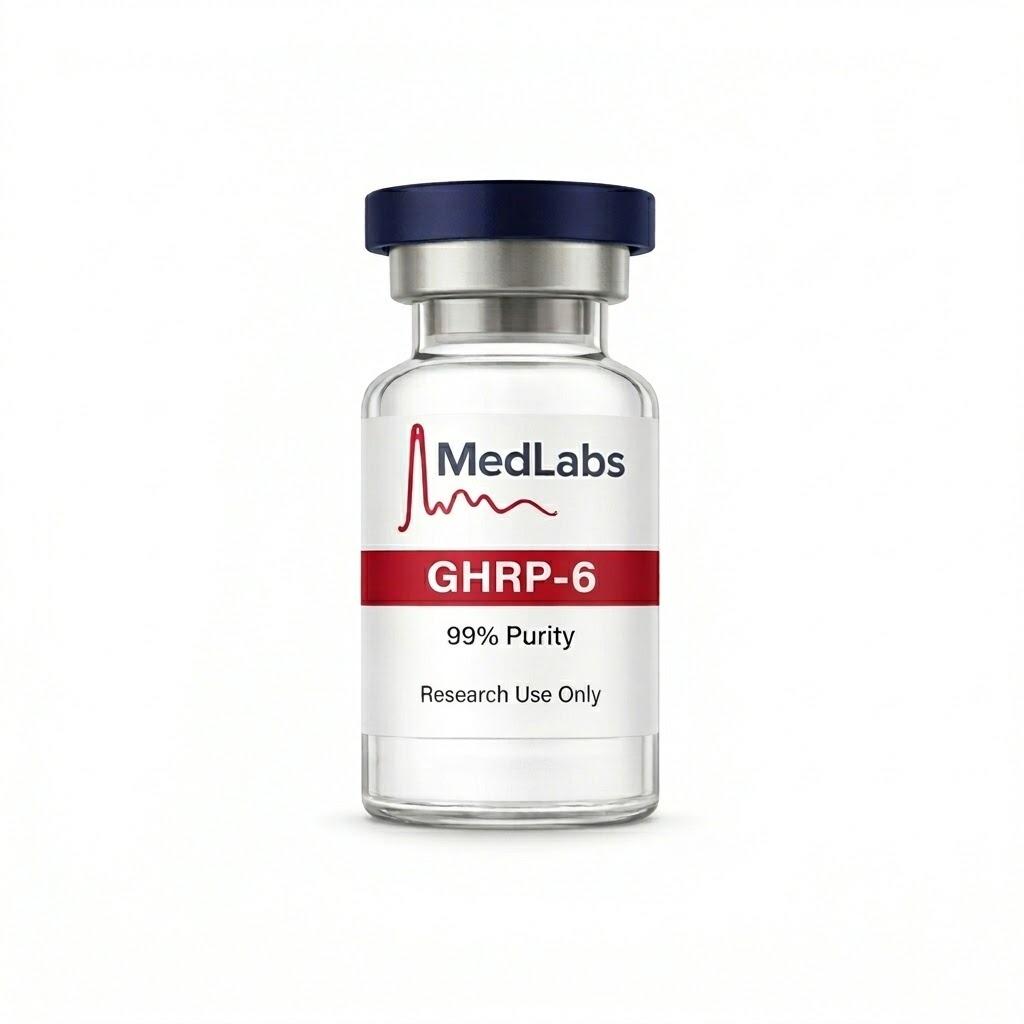
MedLabs Peptides supplies GHRP-6 at ≥99% purity (confirmed by HPLC), in a white to off-white lyophilised powder form, packaged in 5 mg research vials.
Scientific Overview
GHRP-6 belongs to the growth hormone secretagogue (GHS) class of synthetic peptides, which act on the GHS-R1a receptor — a G-protein-coupled receptor (GPCR) expressed across the central nervous system and peripheral tissues. It was among the first synthetic peptides identified as capable of stimulating GHS-R1a independently of endogenous growth hormone-releasing hormone (GHRH).
Peer-reviewed research indexed on PubMed, including foundational work by Bowers et al. (Cell. Mol. Life Sci., 1999) and Howard et al. (Science, 1996), established GHRP-6 as a key molecular tool for receptor pharmacology. Scientific literature indicates that GHRP-6’s GHS-R1a binding properties make it valuable for mechanistic studies of neuroendocrine feedback systems.
Mechanism of Action
Understanding the mechanism of GHRP-6 is central to evaluating its research utility. The peptide binds selectively to the GHS-R1a receptor, initiating a downstream signalling cascade that is well-documented in preclinical literature.
Biological Pathways and Receptor Activity
Upon binding to GHS-R1a, GHRP-6 activates intracellular G-protein pathways, triggering calcium mobilisation from intracellular stores and modulating secondary messenger systems, including the phospholipase C (PLC) and protein kinase C (PKC) cascades. This results in altered signalling within the hypothalamic–pituitary axis under experimental conditions.
Notably, GHRP-6 activates GHS-R1a through a pathway that is distinct from GHRH receptor activation. Therefore, it allows researchers to isolate and study GHS-R1a-specific responses without confounding GHRH-mediated signalling. Studies indexed on PubMed, including the landmark work by Kojima et al. (Nature, 1999) identifying ghrelin as an endogenous GHS-R1a ligand, have reinforced the importance of GHRP-6 as a reference compound in this receptor class.
Additionally, receptor binding studies have explored structure–activity relationships (SAR) using GHRP-6 as a template. Its robust receptor affinity and well-characterised pharmacological profile make it a reliable positive control compound in GPCR-focused research assays.
Research Applications
GHRP-6 has been extensively used across multiple domains of biochemical and physiological research. Its utility extends from cell-based assays to complex in vivo preclinical models.
Laboratory and Experimental Uses
Researchers employ GHRP-6 for the following documented applications:
GHS-R1a Receptor Studies — GHRP-6 serves as a molecular probe to study the activation, desensitisation, and downstream signalling of the growth hormone secretagogue receptor. It is routinely used in receptor binding assays, radioligand displacement experiments, and functional activation studies.
GPCR Signal Transduction Research — In cell-based assay systems, GHRP-6 is applied to examine calcium flux, second messenger dynamics, and GPCR-mediated intracellular events. These assays help characterise how growth hormone secretagogue receptors regulate downstream effector proteins.
Neuroendocrine Pathway Investigation — GHRP-6 is used in animal models and ex vivo tissue preparations to study neuroendocrine regulation within the hypothalamic–pituitary axis. Researchers have used it to examine feedback signalling, receptor expression patterns, and interactions between GHS and somatostatin pathways.
Structure–Activity Relationship (SAR) Studies — As a reference hexapeptide, GHRP-6 is used alongside analogues such as GHRP-2, Ipamorelin, and Hexarelin to compare receptor selectivity, binding affinity, and functional potency. These comparative studies generate data informing the design of next-generation secretagogue research tools.
Preclinical Mechanistic Models — Scientific literature indicates that GHRP-6 has been evaluated in various in vivo experimental settings to study acute hormonal responses under controlled dosing conditions. Outcomes observed in these models are highly dependent on species, experimental design, and exposure parameters.
Comparative Analysis: GHRP-6 vs Related Peptides
Researchers often ask what sermorelin GHRP-6 GHRP-2 do for men in the context of research interest — and this reflects the broader field of GHS peptide comparison. However, it is important to frame this question strictly within preclinical research.
GHRP-6 vs GHRP-2 — Both are GHS-R1a agonists, but they differ in receptor selectivity and potency. GHRP-2 exhibits higher GHS-R1a binding affinity in several in vitro models, whereas GHRP-6 has been more associated with appetite-related signalling in preclinical studies — a property linked to its ghrelin-mimetic activity at hypothalamic circuits. Peer-reviewed research suggests GHRP-6 has a comparatively stronger appetite-stimulating profile in animal models.
GHRP-6 vs Sermorelin — Sermorelin acts on the GHRH receptor rather than GHS-R1a, making it a distinct mechanistic target. Research using both compounds in parallel allows investigators to dissect GHRH-dependent versus GHS-R1a-dependent signalling contributions to hypothalamic–pituitary axis dynamics.
GHRP-6 vs Ipamorelin — Ipamorelin is often described in the literature as a more selective GHS-R1a agonist with a reduced effect on cortisol and prolactin pathways in animal models. GHRP-6, by contrast, has been noted in some preclinical studies to influence a broader range of downstream mediators. Therefore, the choice between these compounds depends on the specificity required by the research design.
MedLabs Peptides supplies several related compounds in this class, including GHRP-2 and Ipamorelin, enabling comparative receptor pharmacology studies from a single trusted research supplier.
Observed Research Insights
Scientific literature on GHRP-6 spans several decades and covers a wide range of experimental observations. The following summarises key themes reported in peer-reviewed studies:
GHS-R1a Activation — GHRP-6 consistently and reproducibly activates GHS-R1a in both in vitro and in vivo research models, making it one of the most characterised ligands for this receptor class.
Calcium Mobilisation — Studies examining intracellular signalling have shown GHRP-6-induced calcium release from intracellular stores, consistent with Gq-protein-coupled signalling mechanisms.
Appetite and Metabolic Signalling — Preclinical literature, including work referenced in the ghrelin discovery studies by Kojima et al. (Nature, 1999), highlights overlap between GHRP-6 activity and endogenous ghrelin pathways. This has prompted research into appetite-related signalling circuits in rodent models. Researchers searching for whether GHRP-6 increases appetite will find that animal studies do report appetite-associated signalling changes; however, these findings are restricted to preclinical experimental contexts.
Muscle and Metabolic Models — Some preclinical studies have investigated GHRP-6 in the context of tissue-level signalling. Questions such as does GHRP-6 increase muscle mass or whether GHRP increase testosterone are frequently encountered in research literature searches. Available evidence is derived exclusively from animal models and in vitro systems; no conclusions regarding human physiology should be drawn from these findings.
Onset of Activity — In preclinical pharmacokinetic models, GHRP-6 demonstrates relatively rapid receptor engagement following administration. Research timelines and dosing regimens are model-specific and cannot be generalised beyond controlled experimental parameters.
Safety and Research Disclaimer
GHRP-6 supplied by MedLabs Peptides is intended strictly for laboratory research use only. It is not approved for, nor intended for, human or veterinary administration, diagnostic use, or therapeutic application of any kind.
Researchers handling GHRP-6 should observe the following precautions:
- The peptide is hygroscopic and should be weighed and handled under dry conditions.
- Reconstitute using sterile water or an appropriate buffered aqueous solution relevant to your assay system.
- If sterility is required, filter through a 0.22 µm membrane immediately before use.
- Aliquot reconstituted solutions and store at –20°C or below. Avoid repeated freeze–thaw cycles, as these may compromise peptide integrity.
- Inspect solutions for precipitation, turbidity, or pH changes before use in sensitive biological assays.
- Peptide activity is concentration-dependent; appropriate dose–response controls are essential for valid experimental outcomes.
- Protect from light and elevated temperatures at all times. Degradation is accelerated under adverse storage conditions.
All regulatory compliance, ethical approvals, and institutional oversight requirements for preclinical research are the responsibility of the purchasing institution. MedLabs Peptides makes no claims regarding therapeutic efficacy, safety in humans, or clinical outcomes.
Conclusion
GHRP-6 remains one of the most extensively characterised growth hormone secretagogue peptides available for biochemical research. Its well-defined mechanism of action at GHS-R1a, robust receptor binding profile, and decades of peer-reviewed literature make it an indispensable tool for investigators studying neuroendocrine signalling, GPCR pharmacology, and hypothalamic–pituitary axis biology.
MedLabs Peptides supplies GHRP-6 at ≥99% purity to support rigorous, reproducible preclinical research. Whether your focus is receptor characterisation, comparative peptide pharmacology, or mechanistic signal transduction studies, GHRP-6 offers a reliable and well-validated molecular platform.
For researchers exploring the broader GHS peptide class, MedLabs Peptides also provides related compounds, including GHRP-2, Ipamorelin, Sermorelin, and Hexarelin — enabling comprehensive, head-to-head receptor studies from a single qualified supplier.
All products are supplied for research purposes only and are not intended for human or veterinary use.
References
- Bowers CY et al. Growth hormone–releasing peptide (GHRP). Cellular and Molecular Life Sciences. 1999. PubMed: 10604470
- Howard AD et al. A receptor in pituitary and hypothalamus that functions in growth hormone release. Science. 1996. PubMed: 8700211
- Ghigo E et al. Growth hormone–releasing peptides. European Journal of Endocrinology. 1997. PubMed: 9010514
- Kojima M et al. Ghrelin is a growth hormone–releasing acylated peptide from the stomach. Nature. 1999. PubMed: 10541310
Reviews
There are no reviews yet.