
Description
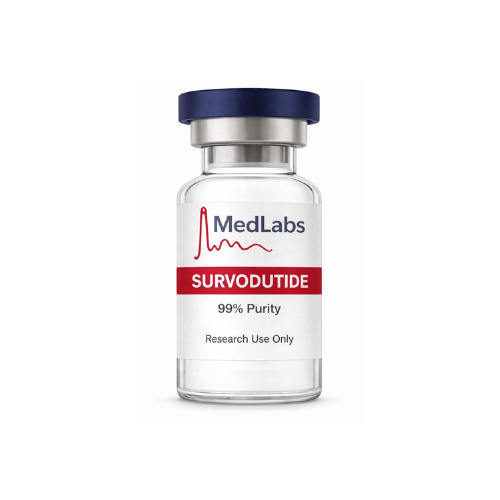
Survodutide Peptide — MedLabs Peptides
⚠️ For Laboratory Use Only: This product, survodutide peptide, is intended strictly for controlled research and analytical purposes.
What Is Survodutide?
The survodutide peptide — also known by its research designation BI 456906 — is a cutting-edge investigational compound developed through a collaboration between Boehringer Ingelheim and Zealand Pharma.
So, what is survodutide exactly? It is a once-weekly dual glucagon/GLP-1 receptor agonist that researchers study for two major conditions — obesity and MASH (metabolic dysfunction-associated steatohepatitis, formerly known as NASH).
What makes survodutide particularly unique is its origin. Unlike most dual agonists that mimic oxyntomodulin, the survodutide peptide works as a direct glucagon analog that simultaneously activates the GLP-1 receptor. This distinction gives it a sharper, more targeted metabolic profile than many competing compounds.
How the Survodutide Peptide Works
The survodutide peptide delivers its effects through two simultaneous receptor pathways. Each pathway contributes a distinct and powerful metabolic response:
- Glucagon Receptor Activation — Directly boosts energy expenditure, accelerates fat breakdown, and drives significant caloric burn even at rest.
- GLP-1 Receptor Activation — Suppresses appetite, slows gastric emptying, and reduces overall caloric intake.
Together, these two pathways produce a powerful, well-researched metabolic effect. Researchers find this dual mechanism especially valuable for studying obesity alongside liver disease — two conditions that frequently occur together.
What Is Survodutide Used For?
MedLabs Peptides supplies the survodutide peptide to support research across two high-priority therapeutic areas:
Obesity & Weight Reduction
Phase 2 clinical trials show that the survodutide peptide produces significant, dose-dependent weight loss. Participants with obesity — defined as a BMI of 27 or above — achieved up to 18.7% body weight reduction at 46 weeks.
This result places survodutide firmly among the top-performing weight loss compounds currently under investigation.
MASH & Liver Fibrosis Treatment
Beyond weight loss, survodutide shows remarkable potential in treating MASH with fibrosis — a serious liver condition with very limited treatment options.
In clinical trials, up to 64.5% of adults with moderate-to-advanced liver fibrosis (F2/F3) experienced measurable improvements without worsening of their MASH condition. This outcome earned survodutide both FDA Fast Track and Breakthrough Therapy Designation for MASH with fibrosis — two of the most significant regulatory endorsements a research compound can receive.
Type 2 Diabetes Research
As of 2026, survodutide is actively enrolling participants in the SYNCHRONIZE™ Phase 3 trials — a series of large-scale studies covering obesity both with and without type 2 diabetes. Researchers expect these trials to further define survodutide’s role in comprehensive metabolic disease management.
Survodutide Dosage — What Research Shows
Understanding survodutide dosage is essential for structuring effective research protocols. Here is what current clinical data indicates:
Survodutide Dosage Overview
| Research Phase | Weekly Dose Range | Observed Outcome |
|---|---|---|
| Low-dose exploration | 0.3 mg | Initial tolerability assessment |
| Mid-range research | 1.2 mg – 3.6 mg | Meaningful weight & liver improvements |
| High-dose protocols | 4.8 mg – 6.0 mg | Peak efficacy — up to 18.7% weight loss |
Researchers follow a gradual dose escalation schedule to allow metabolic adjustment and minimize gastrointestinal side effects. This approach appears consistently across all major survodutide trial protocols.
Note: MedLabs Peptides supplies survodutide strictly for research purposes. All dosage figures reflect published clinical trial data and do not constitute medical advice.
What Is the Difference Between Survodutide and Tirzepatide?
Survodutide vs tirzepatide is one of the most relevant comparisons in current metabolic research. Both target GLP-1 receptors — but their secondary targets differ significantly:
| Feature | Survodutide (BI 456906) | Tirzepatide |
|---|---|---|
| Primary Mechanism | Direct Glucagon Analog | GIP Mimic |
| Receptor Targets | Glucagon R + GLP-1R | GIP R + GLP-1R |
| Developer | Boehringer Ingelheim / Zealand Pharma | Eli Lilly |
| Dosing Frequency | Once Weekly | Once Weekly |
| Peak Weight Loss | Up to 18.7% | Up to 22.5% |
| Liver Disease Data | Strong (MASH/Fibrosis) | Limited |
| FDA Special Status | Fast Track + Breakthrough (MASH) | Approved (Diabetes & Obesity) |
The key difference comes down to the secondary receptor target. Survodutide activates glucagon receptors directly as a glucagon analog, while tirzepatide mimics GIP. This distinction makes survodutide particularly valuable for liver disease research — an area where tirzepatide currently offers much less clinical data.
Survodutide vs Retatrutide — Dual vs Triple Agonist
Survodutide vs retatrutide represents another critical comparison for researchers choosing between next-generation metabolic compounds:
| Feature | Survodutide | Retatrutide |
|---|---|---|
| Receptor Targets | Glucagon R + GLP-1R | GLP-1R + GIP R + Glucagon R |
| Agonist Class | Dual Agonist | Triple Agonist |
| Peak Weight Loss | Up to 18.7% | Up to 24–28% |
| Liver Disease Focus | Strong | Limited |
| FDA Designation | Fast Track + Breakthrough (MASH) | Phase 3 (Obesity/Diabetes) |
Retatrutide adds a third receptor — GIP — to produce higher peak weight loss. However, the survodutide peptide leads clearly in liver fibrosis and MASH research, where retatrutide currently has no comparable data.
Researchers studying metabolic liver disease consistently favor survodutide for its unique and clinically validated hepatic benefits.
FDA Regulatory Status — A Major Research Milestone
The survodutide peptide has achieved two landmark FDA designations for its MASH and fibrosis application:
- Fast Track Designation — Accelerates the development and review process for serious conditions with unmet medical needs
- Breakthrough Therapy Designation — Reserved for drugs showing substantial improvement over existing therapies in early clinical evidence
These designations signal that the FDA recognizes survodutide as a potentially transformative treatment. For researchers, this adds significant weight to the compound’s clinical relevance and long-term research value.
Side Effects — What Researchers Observe
The survodutide peptide produces a side effect profile consistent with other GLP-1 class compounds. Researchers document the following most frequently:
| Side Effect | Severity |
|---|---|
| Nausea | Mild to Moderate |
| Vomiting | Mild to Moderate |
| Diarrhea | Mild to Moderate |
| Constipation | Mild |
These effects typically appear during the early escalation phase and reduce as participants adjust to the compound. Researchers manage these responses effectively through gradual dose titration protocols.
Why Choose MedLabs Peptides for Survodutide?
MedLabs Peptides provides researchers and laboratories with reliable access to the survodutide peptide in fully verified, research-grade form.
Every batch meets strict quality control standards — delivering pure, consistent, and dependable compounds that serious research demands.
When you source survodutide from MedLabs Peptides, you get:
- Research-grade purity
- Sterile, sealed vials
- Consistent batch-to-batch quality
- Reliable supply for Phase-aligned and long-term studies
Storage & Handling of Survodutide Peptide
Protect the integrity of your survodutide peptide supply with proper storage conditions:
- Temperature: -20°C to 4°C (4°F to 39°F)
- Environment: Dry conditions, away from direct sunlight and heat sources
- Handling: Follow all standard sterile laboratory protocols for peptide compounds
Research Applications at MedLabs Peptides
MedLabs Peptides supplies the survodutide peptide to advance research across these critical areas:
- Obesity and significant body weight reduction studies
- MASH and liver fibrosis treatment research
- Dual glucagon/GLP-1 receptor agonist mechanism studies
- Type 2 diabetes and glycemic control protocols
- Cardiovascular risk reduction in metabolic disease
- Comparative studies against tirzepatide, retatrutide, and semaglutide
Reviews
There are no reviews yet.