
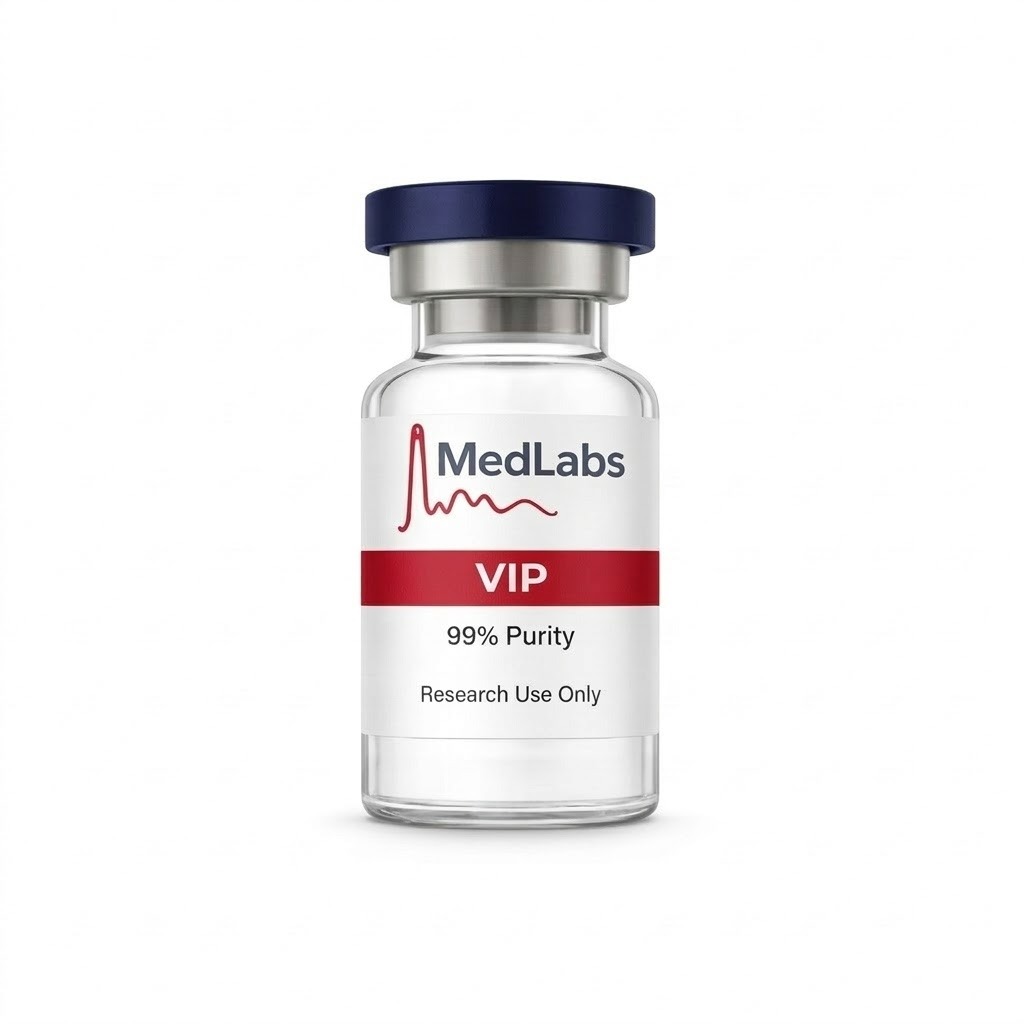
Description
VIP Peptide – Advanced Research Peptide for Neuroimmune & Cellular Signaling Studies
VIP Peptide Research Overview
VIP Peptide, also known as vip vasoactive intestinal peptide, is a highly researched neuropeptide recognized for its broad role in cellular communication, immune signaling, neurological pathways, and gastrointestinal physiology. Naturally occurring within the central and peripheral nervous systems, VIP consists of 28 amino acids and has become a major focus in longevity, neurobiology, and inflammatory response research.
At Medlab Peptides, our research-grade VIP peptides are manufactured to rigorous quality standards for laboratory and investigational applications only. Scientists continue exploring what the peptide is used for due to its apparent involvement in vasodilation, neurotransmission, circadian regulation, intestinal barrier integrity, and immune modulation.
Current experimental models suggest VIP may interact with VPAC1, VPAC2, and PAC1 receptors to influence cyclic AMP (cAMP) signaling pathways linked to cellular homeostasis and metabolic communication. Because these receptors are distributed throughout the nervous system, gastrointestinal tract, lungs, immune tissues, and cardiovascular structures, researchers view VIP intestinal peptide as a promising compound in multi-system signaling studies.
Interest in vip peptide benefits has expanded significantly within anti-aging and longevity research communities due to ongoing investigations into neuroprotection, inflammatory signaling, blood-brain barrier integrity, and tissue communication pathways. Researchers are also studying VIP alongside compounds such as BPC-157, TB-500, SS-31, and MOTS-c in broader peptide-based cellular resilience models.
Medlab Peptides offers premium vip 5mg peptide and vip 10mg peptide formulations intended strictly for research-use-only purposes. Every batch undergoes identity and purity verification to support advanced peptide research protocols.
What Is VIP Peptide?
It refers to Vasoactive Intestinal Peptide, a naturally occurring signaling peptide initially identified in intestinal tissue but now known to exist extensively throughout the nervous and immune systems.
Researchers investigating what does VIP do in the body have linked the peptide to several important biological signaling functions, including:
- Neurotransmitter activity
- Vasodilation signaling
- Immune communication
- Gastrointestinal regulation
- Circadian rhythm signaling
- Cellular stress response pathways
VIP primarily exerts activity through G protein-coupled receptors:
VPAC1 Receptors
Widely distributed in immune tissues, lungs, liver, and intestinal structures.
VPAC2 Receptors
Commonly associated with neurological tissues, endocrine signaling, and circadian regulation.
PAC1 Receptors
Primarily concentrated in the brain and adrenal tissues involved in neuroendocrine communication.
This broad receptor distribution is one reason the peptides continue attracting scientific interest across multiple research disciplines.
VIP Peptide Benefits in Research Models
Neuroimmune Communication Research
One of the most discussed vip peptide benefits involves its apparent role in neuroimmune regulation. Experimental findings suggest VIP signaling may influence communication between immune cells and neural tissues through cytokine modulation and cAMP activation pathways.
Researchers are particularly interested in VIP’s possible interaction with:
- Regulatory T-cell signaling
- Cytokine expression pathways
- Neuroinflammatory responses
- Cellular stress adaptation
These characteristics have made VIP a significant subject within neurodegenerative and longevity-focused investigations.
VIP Peptide and Inflammatory Signaling
VIP intestinal peptide has demonstrated notable activity in experimental inflammatory models. Research suggests the peptide may help regulate immune signaling molecules involved in inflammatory communication networks.
Investigators continue exploring how VIP may influence:
- Cytokine production
- Chemokine signaling
- Intestinal barrier integrity
- Cellular inflammatory balance
In laboratory gastrointestinal models, VIP exposure has been associated with maintenance of tight junction proteins and epithelial barrier support, making it a compelling area of peptide research.
Blood-Brain Barrier & Neurological Research
The peptides are also being studied for their potential role in blood-brain barrier communication and neurological tissue signaling.
Preclinical investigations suggest VIP receptor activity may contribute to:
- Neurovascular communication
- cAMP-mediated neuronal signaling
- Brain immune interactions
- Circadian rhythm synchronization
Researchers studying cognitive aging and neural resilience frequently evaluate VIP alongside mitochondrial peptides such as SS-31 and MOTS-c.
VIP Peptide and Cardiovascular Signaling
Emerging experimental data suggest VIP may participate in vascular and endothelial signaling pathways. Scientists are evaluating the peptide’s relationship with:
- Vascular relaxation signaling
- Endothelial communication
- Cardiac tissue remodeling pathways
- Renin-angiotensin system interactions
Although research remains ongoing, VIP continues to gain attention in studies focused on cardiovascular cellular communication.
VIP Vasoactive Intestinal Peptide in Longevity & Anti-Aging Research
The growing interest in peptides within anti-aging science stems from their potential involvement in:
- Cellular communication
- Neurological signaling
- Mitochondrial resilience
- Circadian rhythm regulation
- Immune system balance
Because aging is increasingly viewed as a multi-system communication process, peptides influencing neuroimmune and metabolic signaling have become central to longevity-focused research models.
Researchers commonly examine VIP alongside:
These compounds are often explored collectively in advanced peptide research environments, investigating cellular adaptation and biological resilience.
VIP 5mg Peptide & VIP 10mg Peptide Options
Medlab Peptides provides both vip 5mg peptide and vip 10mg peptide formats to support varied laboratory research applications.
VIP 5mg Peptide
Suitable for smaller-scale peptide investigations, receptor studies, and exploratory protocols.
VIP 10mg Peptide
Designed for larger-volume laboratory studies requiring extended peptide evaluation.
All Medlab Peptides formulations are:
- Research-use-only
- Third-party tested
- Produced under strict quality standards
- Manufactured for purity and consistency
VIP Peptide Mechanism of Action
VIP appears to activate adenylate cyclase following receptor binding, increasing intracellular cyclic AMP (cAMP) signaling.
This mechanism may influence:
- Immune cell communication
- Neurotransmission pathways
- Smooth muscle signaling
- Cellular stress responses
- Gene transcription pathways
Researchers investigating what are the effects of VIP continue exploring how this peptide coordinates signaling across neurological, gastrointestinal, immune, and vascular systems simultaneously.
VIP Peptide Dosage Research Information
Search interest surrounding peptide administration has increased significantly, including queries regarding vip peptide dosage and how do you take VIP peptide.
However, Medlab Peptides supplies VIP strictly for laboratory and investigational use only.
No clinical dosage recommendations, administration protocols, or therapeutic claims are provided for human consumption. All peptide handling should remain within licensed research settings and comply with applicable regulations.
VIP Peptide Side Effects & Research Considerations
Searches related to ss-31 peptide side effects and peptide safety reflect growing public interest in peptide research generally. In experimental VIP investigations, researchers continue evaluating:
- Receptor sensitivity
- Dose-dependent signaling responses
- Neurovascular interactions
- Cellular adaptation mechanisms
Because VIP remains an investigational compound, ongoing research is necessary to fully characterize its biological profile.
Why Researchers Choose Medlab Peptides
Premium Research Standards
At Medlab Peptides, every peptide batch undergoes rigorous quality assessment to support advanced scientific investigation.
Our Quality Standards Include:
- High-purity peptide synthesis
- Third-party analytical verification
- Research-grade manufacturing
- Secure packaging and storage protocols
Explore Premium Research Peptides
Advance your peptide research with premium VIP formulations designed for scientific precision and laboratory reliability.
Shop Research-Grade Compounds
Discover high-quality peptide solutions developed for advanced longevity, mitochondrial, and neuroimmune research applications.
Browse Lab-Tested Peptide Formulations
Explore Medlab Peptides’ growing catalog of anti-aging and cellular research compounds.
Upgrade Your Peptide Research Collection
Support your next phase of peptide investigation with trusted research materials manufactured to premium standards.
Frequently Asked Questions About VIP Peptide
What is VIP peptide used for?
It is widely studied for its potential role in neuroimmune signaling, inflammatory communication, gastrointestinal physiology, vascular signaling, and neurological research.
What does VIP do in the body?
VIP appears to function as a signaling peptide involved in neurotransmission, vasodilation, immune communication, and circadian rhythm regulation.
What are the effects of VIP?
Experimental models suggest VIP may influence cAMP signaling, cytokine regulation, epithelial barrier integrity, and neurovascular communication pathways.
Who should not take VIP peptide?
Medlab Peptides supplies VIP strictly for laboratory research purposes only. It is not intended for personal, veterinary, or therapeutic use.
What is the difference between VIP 5mg peptide and VIP 10mg peptide?
The primary difference is peptide quantity, allowing researchers flexibility depending on protocol scale and investigational requirements.
Is VIP peptide associated with longevity research?
Yes, they are increasingly explored in anti-aging and longevity-focused studies due to their apparent role in cellular signaling and neuroimmune communication.
Reviews
There are no reviews yet.