
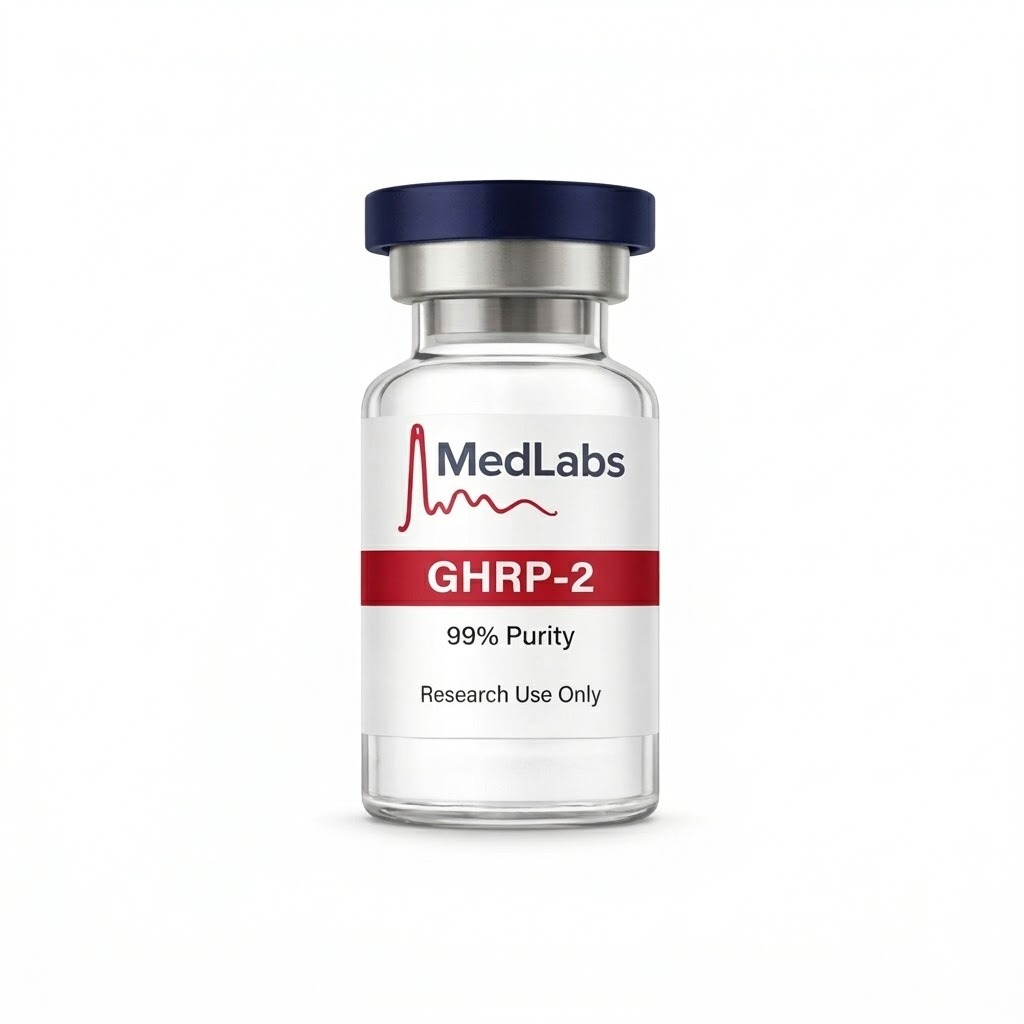
Description
GHRP-2: Complete Research Guide to Mechanism, Benefits, and Peptide Synergy
Introduction
GHRP-2 stands as a widely studied peptide in modern research. Scientists continue to explore its role in growth hormone signaling and metabolic regulation. At MedLabs Peptides, researchers access high-quality compounds designed for laboratory investigation.
Many users search, “What does GHRP-2 peptide do?” This guide addresses that question clearly. Additionally, it explores mechanism, research applications, and comparisons. Therefore, readers gain a structured and reliable overview.
Moreover, interest in GHRP-2 peptides continues to rise. Researchers examine its interaction with other compounds like Mod GRF 1-29. As a result, this peptide blend attracts attention for its synergistic research potential.
What is GHRP-2?
Scientific Overview
GHRP-2 is a synthetic growth hormone-releasing peptide. Scientists classify it as a growth hormone secretagogue (GHS). It interacts with ghrelin receptors in the body.
Ghrelin functions as a natural peptide hormone. It regulates appetite and influences growth hormone release. Therefore, GHRP-2 mimics this biological signaling pathway.
Additionally, GHRP-2 peptides bind to growth hormone secretagogue receptors (GHS-R1a). These receptors exist in the pituitary gland. As a result, researchers observe increased growth hormone pulses in laboratory settings.
Moreover, GHRP-2 is also known as pralmorelin. It contains a specific amino acid sequence that supports receptor binding. Consequently, it remains a key compound in peptide science research.
Mechanism of Action
Biological Pathways and Receptor Activity
GHRP-2 works through ghrelin receptor activation. It binds directly to GHS-R1a receptors. Therefore, it stimulates intracellular signaling pathways.
Once activated, these pathways influence hormone secretion. Growth hormone release increases through pituitary stimulation. Additionally, hypothalamic pathways may contribute to this effect.
Moreover, GHRP-2 can trigger calcium influx in somatotroph cells. This process supports vesicle release of growth hormone. As a result, researchers observe pulsatile hormone patterns.
When combined with Mod GRF 1-29, the mechanism expands. Mod GRF stimulates GHRH receptors. Meanwhile, GHRP-2 activates ghrelin pathways. Therefore, both pathways act together for enhanced signaling.
Scientific literature indicates this dual activation increases efficiency. Studies indexed on PubMed support this synergistic mechanism. Consequently, the blend attracts significant research interest.
Research Applications
Laboratory and Experimental Uses
Researchers use GHRP-2 in controlled laboratory environments. They study its impact on hormone signaling and metabolic processes. Additionally, it supports research into appetite regulation.
Studies show GHRP-2 may influence food intake behavior. For example, controlled trials reported increased caloric consumption. Therefore, researchers link this effect to ghrelin receptor activation.
Moreover, scientists investigate body composition changes. Research suggests increased lean mass in experimental models. However, these findings remain limited to controlled settings.
Additionally, GHRP-2 peptides appear in growth hormone deficiency studies. Researchers examine hormone response patterns over time. As a result, they analyze secretion dynamics and receptor sensitivity.
Furthermore, peptide blends expand research possibilities. Combining GHRP-2 with Mod GRF 1-29 allows dual pathway analysis. Therefore, laboratories gain deeper insight into endocrine signaling.
At MedLabs Peptides, these compounds support structured research protocols. Scientists rely on purity and consistency for accurate results. Consequently, quality sourcing remains essential.
Comparative Analysis: GHRP-2 vs GHRP-6
Researchers often compare GHRP-2 vs. GHRP-6 in laboratory studies. Both peptides belong to the same secretagogue class. However, they show distinct behavioral differences.
GHRP-2 demonstrates stronger growth hormone release in some models. Meanwhile, GHRP-6 often shows a higher appetite stimulation effect. Therefore, selection depends on research goals.
Additionally, GHRP-2 may produce more stable hormonal responses. In contrast, GHRP-6 may cause more pronounced hunger signaling. As a result, researchers choose based on experimental focus.
Another comparison involves combination protocols. Some studies explore what sermorelin, GHRP-6, and GHRP-2 do for men in controlled settings. These combinations aim to analyze multi-pathway stimulation.
However, all findings remain within research frameworks. No conclusions extend beyond laboratory conditions. Therefore, interpretation requires scientific caution.
Observed Research Insights
Scientific literature suggests several key observations. First, GHRP-2 increases growth hormone pulse frequency. This effect appears consistent across multiple studies.
Second, research indicates increased appetite signaling. This aligns with ghrelin receptor activation patterns. Therefore, GHRP-2 influences both endocrine and metabolic pathways.
Third, studies explore hormonal interactions. Researchers examine cortisol, prolactin, and ACTH levels. Some findings suggest mild increases in these markers.
Additionally, questions often arise, such as “Does GHRP increase testosterone?” Current research does not confirm direct testosterone increases. However, indirect hormonal interactions remain under investigation.
Furthermore, GHRP-2 dosage varies across studies. Researchers adjust concentrations based on experimental design. Therefore, no standardized protocol exists.
Peer-reviewed research suggests overall tolerability in animal models. Studies indexed on PubMed report minimal adverse effects under controlled conditions. However, these findings apply strictly to research environments.
Safety & Research Disclaimer
GHRP-2 is strictly intended for research use only. It is not approved for human consumption. Additionally, it is not intended for medical, diagnostic, or therapeutic use.
Researchers must follow proper laboratory protocols. They must handle peptides in controlled environments. Furthermore, they must comply with all regulatory guidelines.
MedLabs Peptides supplies compounds for scientific investigation only. Therefore, all products remain restricted to laboratory use. Users must review all terms before purchasing.
Conclusion
GHRP-2 remains a key compound in peptide research. It plays a significant role in growth hormone signaling studies. Additionally, it supports research into appetite and metabolic pathways.
Its interaction with ghrelin receptors provides valuable insights. Moreover, its combination with Mod GRF 1-29 enhances research potential. Therefore, scientists continue to explore its applications.
Comparisons like GHRP-2 vs 6 further expand understanding. Each peptide offers unique research advantages. As a result, selection depends on experimental goals.
At MedLabs Peptides, researchers access reliable peptide solutions. This supports consistent and accurate scientific work. Ultimately, GHRP-2 continues to shape modern peptide research.
Reviews
There are no reviews yet.