
Description
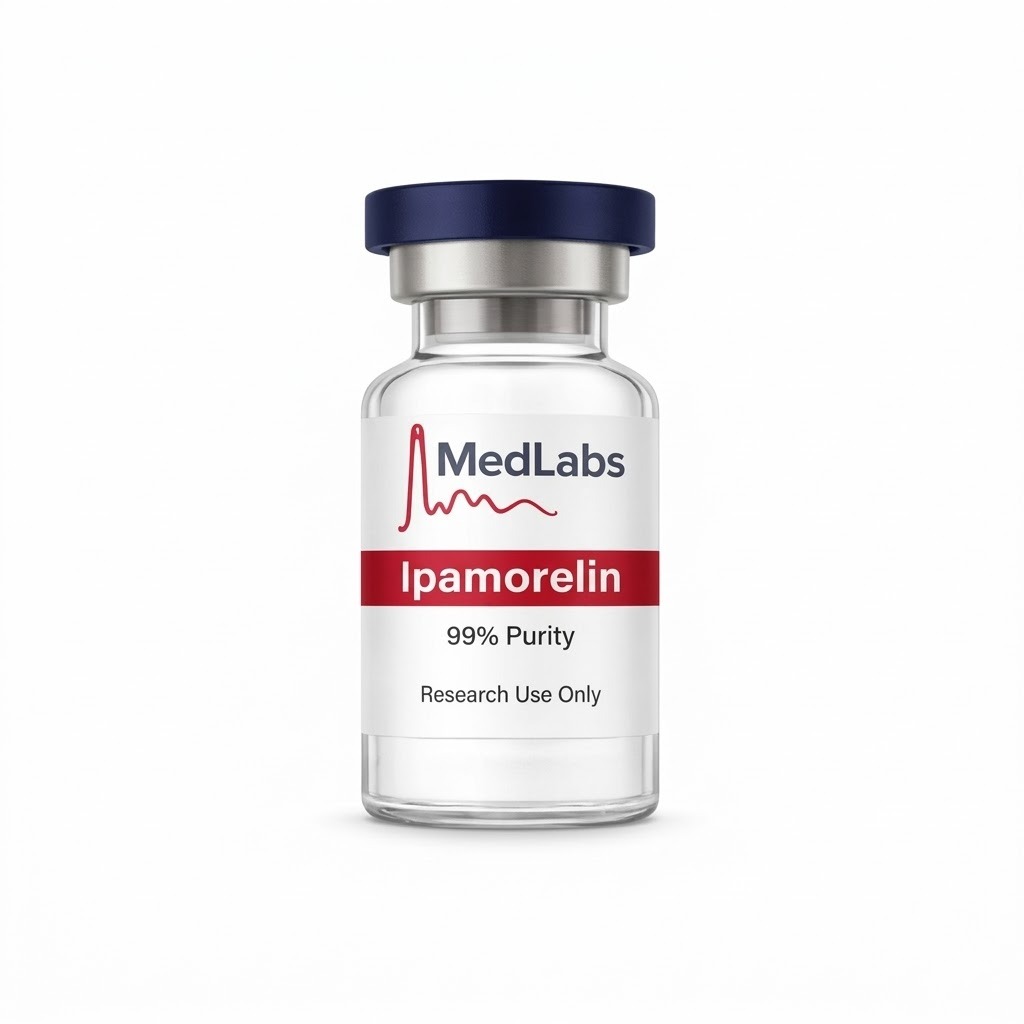
Buy Ipamorelin Peptide – Research Grade Growth Hormone Secretagogue
Quick Specifications
- Compound Name: Ipamorelin
- Chemical Formula: C₃₈H₄₉N₉O₅
- Molecular Weight: 711.85 g/mol
- CAS Number: 170851-70-4
- Purity: ≥98% (HPLC verified)
- Appearance: White to off-white lyophilized powder
- Solubility: Soluble in bacteriostatic water or sterile aqueous solutions
- Storage: -20°C (long-term), 2–8°C (short-term after reconstitution)
- Half-Life: ~2 hours
- Pack Size: 5mg / 10mg vials (custom sizes available)
Overview
Ipamorelin is a synthetic pentapeptide classified as a selective growth hormone secretagogue (GHS). It is widely studied for its ability to stimulate endogenous growth hormone (GH) release through targeted receptor interaction. Unlike earlier growth hormone-releasing peptides (GHRPs), Ipamorelin demonstrates a high degree of receptor selectivity.
Structurally, Ipamorelin mimics the endogenous hormone ghrelin and interacts with the growth hormone secretagogue receptor (GHS-R1a). This selectivity makes it a valuable compound in controlled laboratory settings focused on endocrine signaling and metabolic pathways.
Due to its short half-life and targeted activity, Ipamorelin is frequently evaluated in comparative peptide research, including studies involving combinations such as CJC-1295 Ipamorelin protocols. Its predictable pharmacokinetic profile supports reproducible experimental conditions. Buy Ipamorelin
Mechanism of Action of Ipamorelin
Ipamorelin functions by selectively binding to the GHS-R1a receptor located in the pituitary and hypothalamus. This interaction triggers intracellular signaling pathways that promote pulsatile secretion of growth hormone without significantly elevating other hormones such as cortisol or prolactin.
Researchers often explore what does the Ipamorelin peptide do at a cellular level by analyzing its role in calcium ion influx and downstream GH release signaling. Compared to other GHRPs, Ipamorelin exhibits minimal off-target receptor activation, making it suitable for precise mechanistic studies.
In experimental models, combinations like CJC-1295 + Ipamorelin are used to evaluate synergistic effects between GHRH analogues and GHS compounds. This allows investigation into sustained vs. pulsatile GH release dynamics. Buy Ipamorelin
Additional research questions—such as does Ipamorelin raise testosterone levels or does Ipamorelin reduce belly fat—are typically explored within broader endocrine and metabolic pathway studies rather than isolated peptide activity.
Research Applications
- Cell-based growth hormone secretion assays
- Animal model studies on endocrine regulation
- Receptor binding affinity and selectivity analysis
- Comparative studies with GHRPs and GHRH analogues (e.g., CJC-1295 Ipamorelin)
- Signal transduction pathway research involving GHS-R1a activation
- Metabolic and adipose tissue response investigations
- Peptide stability and pharmacokinetic profiling
Common Research Questions
What is Ipamorelin used for in research?
Ipamorelin is used to study growth hormone signaling, receptor selectivity, and endocrine system modulation in controlled laboratory environments.
What does Ipamorelin do to the body in experimental models?
It stimulates GH release via GHS-R1a receptor activation, supporting studies on metabolism, recovery pathways, and hormonal regulation.
Does Ipamorelin reduce belly fat in research settings?
This question is explored in metabolic studies examining GH-related lipolysis pathways rather than direct fat-targeting mechanisms.
Does Ipamorelin raise testosterone levels?
Current research focuses on indirect endocrine interactions; Ipamorelin is not primarily classified as an androgen-modulating compound.
Is Ipamorelin safer than HGH in laboratory comparisons?
Studies often compare endogenous GH stimulation (Ipamorelin) vs. exogenous GH administration to evaluate signaling differences and feedback mechanisms.
Will Ipamorelin make subjects gain muscle in studies?
Muscle-related outcomes are typically secondary endpoints in GH pathway research, not direct effects of the compound alone.
How to reconstitute CJC-1295 Ipamorelin 5mg for research use?
Reconstitution protocols vary by laboratory standards but generally involve sterile bacteriostatic water under controlled conditions.
Handling & Storage
- Store lyophilized peptide at -20°C for long-term stability
- After reconstitution, store at 2–8°C and use within the recommended timeframe
- Protect from repeated freeze-thaw cycles
- Avoid direct light exposure
- Reconstitute using sterile bacteriostatic water under aseptic conditions
- Gently swirl—do not shake—to preserve peptide integrity
Safety & Compliance
- FOR RESEARCH USE ONLY
- Not for human or veterinary use
- Not intended for diagnostic, therapeutic, or clinical applications
- All handling must be performed by qualified professionals in appropriate laboratory settings
- The purchaser assumes full responsibility for safe handling, storage, and use in compliance with applicable regulations
Jonson A –
This felt very smooth in terms of effects. Over time I noticed better recovery and deeper rest cycles, which helped my overall performance.