
Description
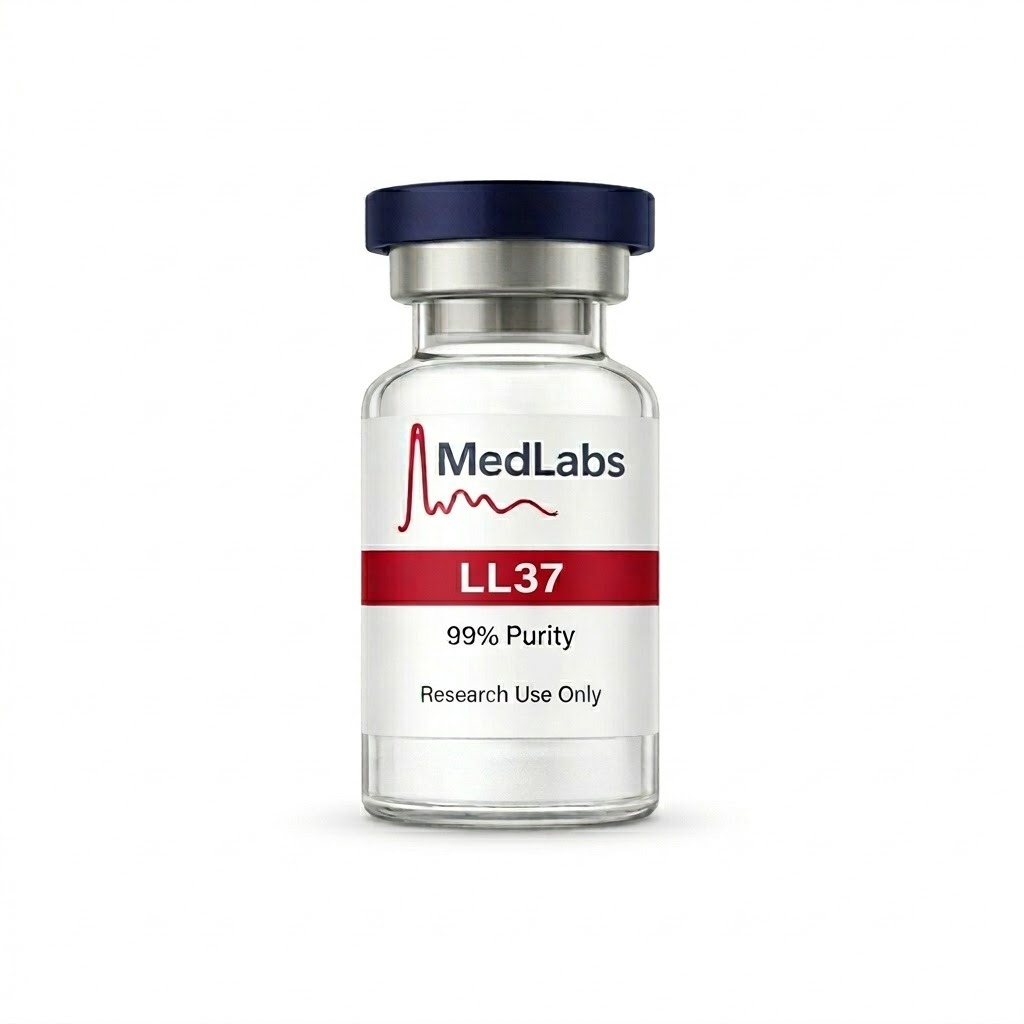
LL-37 Peptide – Antimicrobial Cathelicidin Research Profile
Overview of LL-37
LL-37 is a cationic antimicrobial peptide widely studied in immunological research.
Researchers classify the LL-37 peptide as part of the cathelicidin family.
LL-37 peptide forms from the cleavage of the hCAP18 protein in immune cells.
Therefore, neutrophils and epithelial cells actively produce this peptide.
Scientists investigate the peptide benefits in antimicrobial defense and immune modulation.
Moreover, studies connect this compound to inflammation signaling and tissue response.
At Medlab Peptides, medlabspeptides.com provides research-grade it for controlled laboratory studies.
Consequently, researchers gain consistent material for advanced experimental protocols.
Quick Specifications
- Molecular Formula: C205H340N50O53
- Molecular Weight: 4493.34 g/mol
- CAS Number: Not consistently assigned
- Purity: ≥98% (research grade)
- Appearance: White to off-white lyophilized powder
- Storage: Store at -20°C, desiccated
- Solubility: Soluble in sterile water or buffered solutions
- Pack Size: 5mg / 10 mg/custom quantities
Mechanism of Action of LL-37 Peptide
Membrane Interaction and Antimicrobial Activity
The peptide interacts directly with microbial membranes through electrostatic attraction.
As a result, it disrupts lipid bilayers and compromises pathogen integrity.
Additionally, the peptide may form pores or induce membrane destabilization.
Therefore, researchers explore its role against bacteria, fungi, and viral models.
Immune Modulation and Inflammatory Pathways
The peptide influences immune signaling through Toll-like receptor pathways.
Furthermore, it enhances recognition of nucleic acids by immune cells.
Because of this, researchers study how LL-37 affects inflammation in tissue models.
Moreover, cytokine expression appears to be regulated through receptor-mediated pathways.
Cell Signaling and Tissue Repair Mechanisms
The peptide promotes angiogenesis and endothelial cell proliferation.
For example, it supports vascular formation in wound-healing models.
Consequently, the peptide benefits include modulation of cell migration and repair signals.
Additionally, interactions with scavenger receptors influence intracellular signaling cascades.
Research Applications of LL-37
- Cell-based research on immune cell activation
- Animal model studies on inflammation and tissue repair
- Receptor binding studies involving membrane interaction
- Comparative peptide research with antimicrobial compounds
- Signal transduction studies in cytokine and TLR pathways
Common Research Questions About LL-37
What does the LL-37 peptide do in research models?
Researchers use it to study antimicrobial defense and immune response signaling.
Additionally, it supports studies on inflammation and tissue regeneration pathways.
Which cells produce LL-37 in biological systems?
Neutrophils, epithelial cells, and immune-related cells produce it.
Therefore, it plays a key role in innate immune responses.
What diseases are linked to LL-37 expression in studies?
Research links psoriasis models with elevated peptide expression.
Moreover, studies explore the peptide cancer and inflammatory disease associations.
Does LL-37 affect inflammation signaling pathways?
Yes, the influences cytokine release and Toll-like receptor activation.
Thus, it remains relevant in immunology-focused research.
LL-37 vs other antimicrobial peptides in research?
It differs due to its dual antimicrobial and immunomodulatory functions.
Meanwhile, other peptides may show narrower activity profiles.
Handling and Storage Guidelines
- Store LL-37 at -20°C for long-term preservation
- Protect from light and humidity exposure
- Reconstitute with sterile water under aseptic conditions
- Avoid repeated freeze-thaw cycles
- Use prepared solutions promptly for stability
Safety and Compliance
LL-37 is strictly FOR RESEARCH USE ONLY.
It is not approved for human or veterinary applications.
Furthermore, this peptide is not intended for therapeutic use.
Researchers must follow all laboratory safety protocols.
Medlab Peptides ensures high-quality research compounds for scientific use.
Therefore, qualified professionals assume full responsibility for handling.
Reviews
There are no reviews yet.