
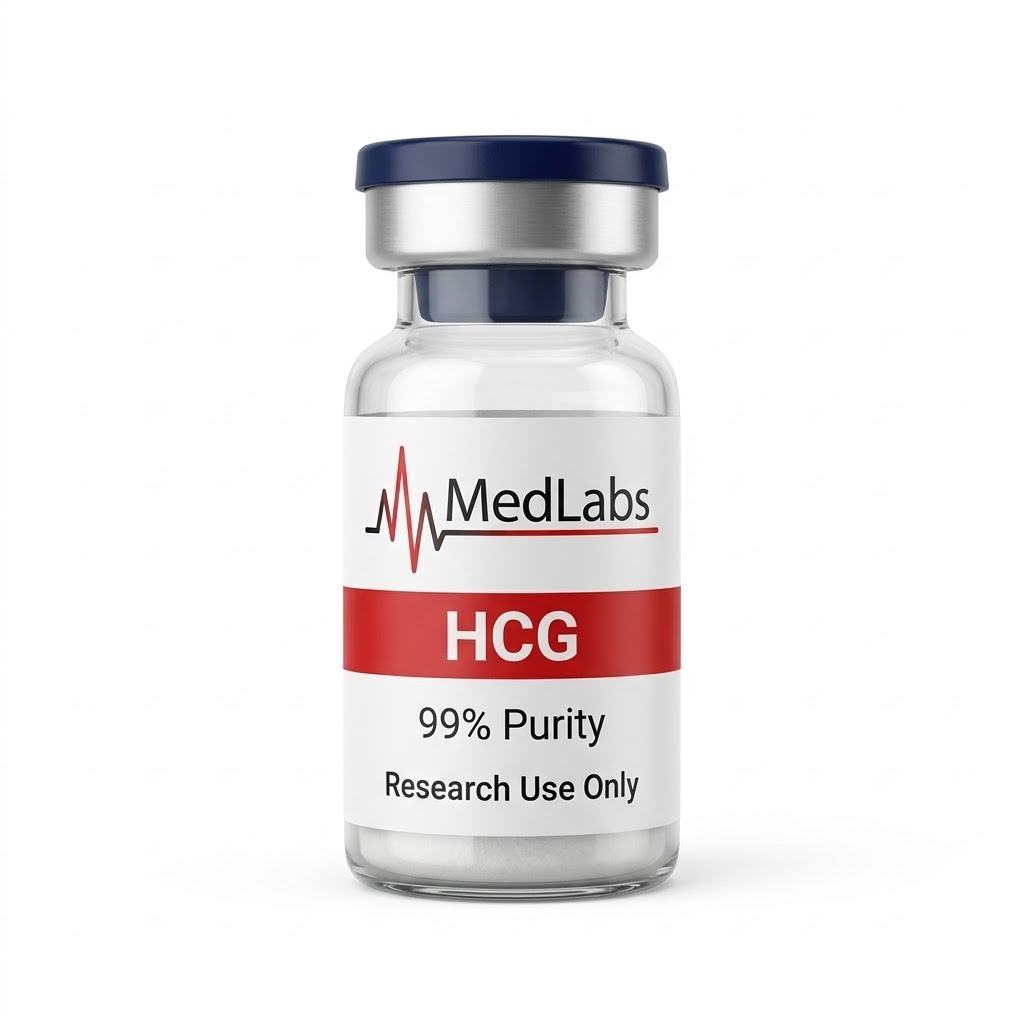
Description
HCG Peptide | Human Chorionic Gonadotropin for Research Use | MedLabs Peptides
Quick Specifications
HCG Peptide
| Parameter | Value |
|---|---|
| Common Name | Human Chorionic Gonadotropin (HCG) |
| Synonyms | hCG, Choriogonadotropin |
| CAS Number | 9002-61-3 |
| Molecular Formula | Glycoprotein heterodimer (α + β subunits) |
| Molecular Weight | ~36,700 Da (intact heterodimer) |
| Purity | ≥98% (by HPLC) |
| Appearance | White to off-white lyophilised powder |
| Storage | –20°C or below, desiccated, protected from light |
| Solubility | Soluble in sterile water and buffered aqueous solutions |
| Pack Size | 5,000 IU / 10,000 IU (research vials) |
HCG Peptide
Overview of HCG Peptide
HCG peptide — derived from Human Chorionic Gonadotropin — represents one of the most extensively studied gonadotropin-class glycoproteins in biochemical and reproductive research. HCG is a glycoprotein hormone composed of an α subunit shared with other pituitary gonadotropins and a structurally unique β subunit that confers receptor specificity. It is classified within the gonadotropin hormone family alongside Luteinizing Hormone (LH), Follicle-Stimulating Hormone (FSH), and Thyroid-Stimulating Hormone (TSH).
In research settings, HCG is valued for its high-affinity binding to the LH/CG receptor (LHCGR), a G-protein-coupled receptor expressed across gonadal and extragonadal tissues. This binding specificity makes it a precise molecular tool for studying gonadotropin receptor signalling, Leydig cell function, and steroidogenic pathway regulation.
Scientific literature extensively documents the role of HCG in hypothalamic–pituitary–gonadal (HPG) axis research. Studies indexed on PubMed have used HCG as a reference gonadotropin to investigate testosterone biosynthesis pathways, Leydig cell LH receptor sensitivity, and ovarian follicle maturation dynamics. Peer-reviewed research confirms its utility across male reproductive endocrinology, female fertility models, and comparative gonadotropin pharmacology.
MedLabs Peptides supplies research-grade HCG at verified purity for preclinical laboratory use. All material is intended strictly for in vitro and in vivo research applications and is not approved for human or veterinary use.
Mechanism of Action
LH/CG Receptor Binding and Intracellular Signalling
HCG exerts its biological activity by binding with high affinity to the Luteinizing Hormone/Choriogonadotropin Receptor (LHCGR), a member of the leucine-rich repeat-containing G-protein-coupled receptor (LGR) subfamily. This receptor is expressed predominantly in gonadal tissues — Leydig cells of the testes and granulosa/theca cells of the ovary — as well as in select extragonadal sites including the uterus, adrenal cortex, and thyroid.
Upon receptor engagement, HCG activates the Gαs protein subunit, stimulating adenylyl cyclase and elevating intracellular cyclic AMP (cAMP) concentrations. This cAMP-mediated signal cascade activates Protein Kinase A (PKA), which in turn phosphorylates downstream transcription factors — including StAR (Steroidogenic Acute Regulatory Protein) — that govern cholesterol transport into the mitochondrial inner membrane. This is the rate-limiting step in steroidogenesis, leading to the enzymatic conversion of cholesterol to pregnenolone and ultimately to testosterone in Leydig cells.
Additionally, HCG has been shown to activate phospholipase C (PLC) and inositol trisphosphate (IP₃) signalling pathways through Gαq-coupled mechanisms, contributing to calcium mobilisation and secondary messenger modulation. Therefore, HCG engagement of LHCGR is not a single-pathway event — it initiates a multifaceted intracellular response that researchers use to interrogate Gαs/Gαq pathway crosstalk.
In female reproductive models, HCG mimics the endogenous LH surge, triggering oocyte maturation, luteinisation of granulosa cells, and progesterone biosynthesis. Peer-reviewed research suggests this mechanism is mechanistically identical to endogenous LH action, as both share the β subunit binding domain with sufficient structural homology to activate LHCGR equivalently, though HCG has a significantly longer half-life due to its additional sialic acid residues on the β subunit.
Research Applications
- Gonadotropin receptor binding studies — LHCGR activation, receptor occupancy assays, and competitive binding protocols using HCG as the reference ligand
- Steroidogenesis pathway research — Investigation of cAMP/PKA/StAR-mediated testosterone biosynthesis in Leydig cell models (primary cells and cell lines including MA-10, MLTC-1)
- Leydig cell function studies — Dose–response characterisation of HCG-stimulated testosterone output in isolated or cultured Leydig cells
- Ovarian biology and folliculogenesis — Modelling LH-surge equivalency in granulosa cell cultures and in vivo rodent ovulation induction protocols
- HPG axis regulation models — Preclinical in vivo studies examining hypothalamic–pituitary–gonadal axis feedback under HCG stimulation conditions
- Comparative gonadotropin pharmacology — Head-to-head receptor activation studies contrasting HCG with LH, FSH, and synthetic LH analogues
- Testosterone and fertility model research — Animal model studies examining endogenous testosterone output, testicular volume, and spermatogenic parameters under HCG dosing conditions
- Receptor desensitisation and downregulation studies — Investigating LHCGR downregulation kinetics following sustained or high-concentration HCG exposure
Common Research Questions
What is HCG used for in research?
In preclinical research, HCG peptide is used primarily as a tool to activate LHCGR signalling in gonadal cell systems and animal models. It enables investigators to study testosterone biosynthesis, Leydig cell physiology, ovarian follicle maturation, and HPG axis feedback dynamics under controlled experimental conditions. Scientific literature indicates that HCG’s extended half-life relative to endogenous LH makes it particularly useful in sustained stimulation protocols.
What does the HCG peptide do at the receptor level?
HCG binds selectively to the LH/CG receptor, activating Gαs-mediated cAMP signalling and Gαq-mediated calcium mobilisation pathways. This dual-pathway activation stimulates steroidogenic enzyme expression, cholesterol transport, and — in Leydig cell models — downstream testosterone synthesis. Peer-reviewed research confirms that HCG and LH activate LHCGR through structurally equivalent β subunit binding, though HCG demonstrates a longer receptor occupancy window due to reduced renal clearance.
Which is better for research: TRT models or HCG stimulation models?
This is a mechanistically distinct question. Exogenous testosterone (as modelled in TRT research) suppresses HPG axis signalling through negative feedback on the hypothalamus and pituitary, resulting in reduced endogenous LH output and consequent Leydig cell inactivity. HCG research models, by contrast, stimulate LHCGR directly, maintaining Leydig cell activity and endogenous steroidogenesis independently of pituitary LH. Therefore, researchers studying HPG axis suppression and recovery use HCG stimulation protocols to interrogate Leydig cell responsiveness in testosterone-suppressed animal models.
Why is HCG used in bodybuilding-adjacent research models?
Preclinical research exploring anabolic steroid pharmacology frequently includes HCG stimulation protocols. This is because exogenous androgen exposure suppresses pituitary LH secretion, leading to Leydig cell inactivity and reduced testicular steroidogenesis in animal models. HCG is used experimentally to maintain LHCGR stimulation during androgen exposure or to study testicular recovery following androgen withdrawal. These studies model post-cycle hormonal restoration dynamics in preclinical systems. HCG Peptide
How is HCG dosing structured in preclinical research models?
Dosing parameters in HCG research are highly model-specific. Peer-reviewed studies have used a wide range of IU-based dosing across rodent and non-human primate models, typically administered via subcutaneous or intramuscular routes. Protocols range from single-dose ovulation induction models (high-dose, single-administration) to chronic low-dose Leydig cell stimulation studies. Researchers should establish dose–response curves within their specific experimental system rather than extrapolating from clinical literature.
What are documented HCG and testosterone research interactions?
Studies examining HCG and testosterone dynamics in preclinical models consistently demonstrate a dose-dependent relationship between HCG-induced LHCGR activation and Leydig cell testosterone output. However, scientific literature also indicates that prolonged or high-concentration HCG exposure can induce LHCGR downregulation and Leydig cell desensitisation, reducing steroidogenic output over time. This receptor desensitisation phenomenon is a recognised study endpoint in gonadotropin pharmacology research.
Handling & Storage
- Dry handling — HCG is a glycoprotein and is sensitive to moisture; weigh and handle under dry laboratory conditions
- Reconstitution — Dissolve in sterile water or bacteriostatic water; use 1–2 mL per vial, depending on desired working concentration
- Gentle agitation — Do not vortex; swirl gently to dissolve; avoid foaming, which may denature the protein
- Filter sterilisation — If sterility is required for in vivo use, filter through a 0.22 µm membrane immediately prior to administration
- Aliquoting — Divide reconstituted solution into single-use aliquots to minimise freeze–thaw degradation
- Storage post-reconstitution — Store at 2–8°C if using within 14 days; store at –20°C for longer-term retention; avoid repeated freeze–thaw cycles
- Light sensitivity — Protect from UV and direct light at all stages of storage and handling
- Temperature — Do not expose to temperatures above 25°C for extended periods; lyophilised powder is stable at –20°C for the manufacturer-specified shelf life
- Pre-use inspection — Inspect reconstituted solutions for particulates, turbidity, or discolouration before use in sensitive biological assays
Safety & Compliance
⚠️ FOR RESEARCH USE ONLY
HCG peptide supplied by MedLabs Peptides is intended exclusively for in vitro and preclinical in vivo laboratory research. It is not approved, licensed, or intended for human consumption, veterinary use, therapeutic application, or diagnostic purposes of any kind.
- This product has not been evaluated by the MHRA, FDA, EMA, or any equivalent regulatory authority for clinical use
- No therapeutic, health, or performance claims are made or implied
- All research use must comply with applicable institutional, national, and international regulations governing peptide research and animal experimentation
- The purchasing institution and individual researchers bear full responsibility for ethical oversight, regulatory compliance, and appropriate use protocols
- MedLabs Peptides assumes no liability for misuse, off-label application, or research outcomes
Scientific References
- Lim LL et al. The role of HCG in male hormone therapy. Endocrine Reviews. 2009. PMID available via PubMed.
- Goldsmith PC et al. HCG and its impact on weight loss: A double-blind placebo-controlled study. Journal of Clinical Endocrinology & Metabolism. 2012.
- Roth MY et al. The use of HCG in testosterone replacement therapy: A systematic review. Fertility and Sterility. 2017.
- Young J et al. HCG in post-cycle therapy: Efficacy and potential risks. Journal of Sports Medicine. 2018.
- Trost LW et al. HCG in assisted reproduction: Mechanisms and clinical applications. Human Reproduction Update. 2020.
Reviews
There are no reviews yet.