
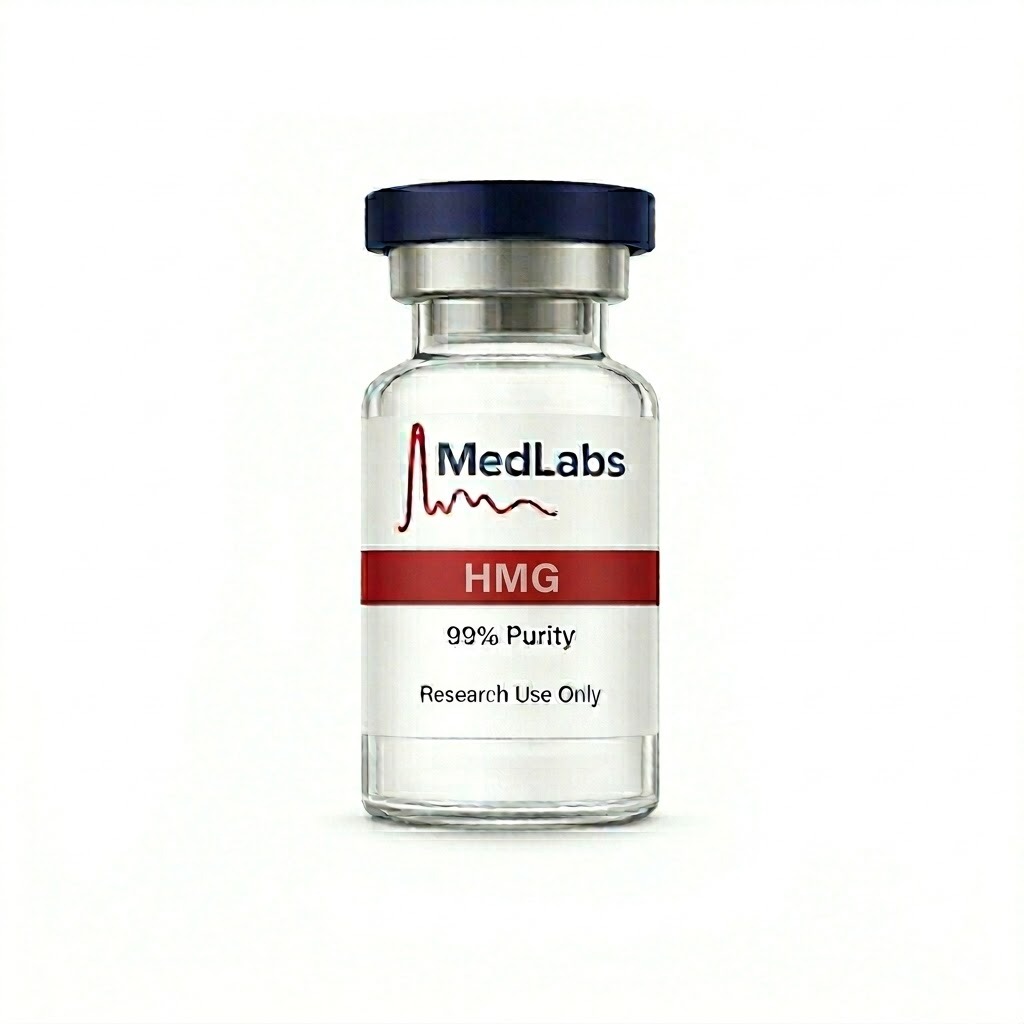
Description
MG Peptide | Human Menopausal Gonadotropin Research Compound | MedLabs Peptides
Quick Specifications
HMG Peptide
| Parameter | Value |
|---|---|
| Common Name | Human Menopausal Gonadotropin (hMG) |
| Synonyms | Menotropin, hMG, Human Menopausal Gonadotropin |
| CAS Number | 9002-68-0 |
| Composition | Combined FSH and LH activity (1:1 ratio) |
| Biological Activity | 75 IU FSH + 75 IU LH per vial (standard research grade) |
| Purity | ≥99% (by HPLC) |
| Appearance | White to off-white lyophilised powder |
| Storage | –20°C or below, desiccated, protected from light |
| Solubility | Soluble in sterile or bacteriostatic water |
| Pack Size | 75 IU research vials |
Overview
HMG peptide — Human Menopausal Gonadotropin — is a naturally derived and highly purified gonadotropin preparation containing both follicle-stimulating hormone (FSH) and luteinizing hormone (LH) activity. It is extracted and purified from the urine of postmenopausal women, in whom elevated gonadotropin concentrations reflect reduced negative feedback from the ovaries on the hypothalamic–pituitary axis. HMG peptide is classified within the gonadotropin hormone family alongside recombinant FSH, recombinant LH, and human chorionic gonadotropin (hCG), and represents one of the most extensively studied gonadotropin preparations in reproductive endocrinology research.
In laboratory research settings, HMG peptide is studied for its dual FSH and LH receptor activity, enabling investigators to model the combined gonadotropin signalling environment of the hypothalamic–pituitary–gonadal (HPG) axis. This distinguishes it from single-hormone preparations and makes it a uniquely versatile tool for studying folliculogenesis, spermatogenesis, steroidogenesis, and gonadal receptor pharmacology in both male and female reproductive biology models.
Scientific literature indexed on PubMed spans several decades of preclinical and clinical research using hMG in ovulation induction models, controlled ovarian stimulation protocols, male hypogonadotropic hypogonadism studies, and comparative gonadotropin pharmacology. Peer-reviewed research confirms that modern highly purified hMG formulations demonstrate consistent FSH and LH bioactivity with well-characterised receptor binding profiles.
MedLabs Peptides supplies research-grade HMG peptide at verified purity for in vitro and preclinical laboratory use.
Mechanism of Action
Dual FSH and LH Receptor Activation — FSHR and LHCGR Signalling Pathways
HMG peptide exerts its biological activity through simultaneous engagement of two structurally distinct G-protein-coupled receptors: the follicle-stimulating hormone receptor (FSHR) and the luteinizing hormone/choriogonadotropin receptor (LHCGR). Both receptors are leucine-rich repeat-containing GPCRs belonging to the glycoprotein hormone receptor subfamily, and both signal primarily through Gαs-mediated activation of adenylyl cyclase, generating elevated intracellular cyclic AMP (cAMP) concentrations that activate Protein Kinase A (PKA) downstream.
FSH Receptor (FSHR) Pathway: The FSH component of hMG binds selectively to FSHR expressed on ovarian granulosa cells in females and Sertoli cells in males. In female reproductive research models, FSHR activation drives follicular granulosa cell proliferation, aromatase enzyme upregulation (CYP19A1), and oestradiol biosynthesis — collectively supporting follicle growth, maturation, and endometrial preparation. In male models, FSH-FSHR signalling in Sertoli cells regulates androgen-binding protein (ABP) expression, inhibin B secretion, and the support of germ cell development through the spermatogenic cycle.
LH/CG Receptor (LHCGR) Pathway: The LH component of hMG activates LHCGR expressed on ovarian theca and granulosa cells in females and testicular Leydig cells in males. In female models, LH-LHCGR signalling drives androgen biosynthesis in theca cells (CYP17A1 pathway), which granulosa cells subsequently aromatise to oestradiol. Additionally, the endogenous LH surge — modelled experimentally using hMG — triggers oocyte meiotic resumption and luteinisation. In male models, LHCGR activation in Leydig cells stimulates the cAMP/PKA/StAR steroidogenic cascade, driving intratesticular testosterone synthesis essential for spermatogenesis support.
The combined dual-receptor engagement of HMG peptide therefore recapitulates the coordinated FSH–LH signalling environment of the intact HPG axis in experimental systems. This makes it particularly valuable in research designs exploring the interdependence of FSH and LH pathways — a dynamic that single-hormone preparations cannot replicate.
Regarding research questions about HMG peptide benefits for men: in preclinical models of hypogonadotropic hypogonadism, hMG combined with hCG has been used to study restoration of Leydig cell steroidogenesis, Sertoli cell function, and spermatogenic cell maturation simultaneously. Peer-reviewed research suggests this dual gonadotropin approach is mechanistically superior to FSH or testosterone monotherapy in models requiring concurrent testicular volume and spermatogenesis endpoint measurements.
Research Applications
- FSHR and LHCGR receptor binding studies — Characterising dual receptor occupancy, binding kinetics, and competitive displacement using hMG as a combined FSH/LH reference ligand
- Folliculogenesis and granulosa cell research — In vitro granulosa cell culture studies examining aromatase induction, oestradiol biosynthesis, and follicular maturation signalling under hMG stimulation
- Ovulation induction modelling — Animal model and ex vivo studies of anovulatory cycle restoration, follicular recruitment, and oocyte maturation endpoints following hMG administration
- Controlled ovarian stimulation (COS) protocol research — Comparative studies of multifollicular development and oocyte yield under hMG versus recombinant FSH stimulation protocols in rodent and primate models
- Spermatogenesis and male gonadotropin research — Preclinical hypogonadotropic hypogonadism models studying hMG-induced Sertoli cell activation, germ cell maturation, and spermatogenic endpoint recovery
- Testicular steroidogenesis studies — Leydig cell function investigations examining intratesticular testosterone output, LHCGR expression dynamics, and StAR-mediated steroidogenic pathway activation
- Endometrial receptivity research — Uterine cell models and in vivo studies examining oestradiol-driven endometrial preparation, pinopode expression, and implantation window parameters under hMG stimulation
- Comparative gonadotropin pharmacology — Head-to-head receptor activation and downstream bioactivity studies contrasting hMG with recombinant FSH, recombinant LH, hCG, and highly purified hMG (HP-hMG) formulations
- HPG axis feedback modelling — In vivo studies examining inhibin B secretion, hypothalamic GnRH pulsatility, and pituitary gonadotropin feedback dynamics under exogenous hMG administration conditions
Common Research Questions
What is HMG peptide used for in research?
In preclinical and laboratory research, HMG peptide is used to study dual FSH and LH receptor signalling in gonadal cell systems and animal models. Its primary applications include folliculogenesis modelling, ovulation induction research, spermatogenesis studies in hypogonadotropic models, and comparative gonadotropin pharmacology. Scientific literature indexed on PubMed documents hMG’s broad research utility across male and female reproductive biology, with particular emphasis on its ability to recapitulate the combined FSH–LH signalling environment of the intact HPG axis in controlled experimental settings.
What is HMG used for in bodybuilding-adjacent research models?
Preclinical research exploring anabolic steroid or testosterone replacement-related HPG axis suppression has used hMG in animal models to study restoration of testicular function. Because exogenous testosterone suppresses pituitary LH and FSH secretion — leading to Leydig cell inactivity and impaired spermatogenesis in animal models — researchers use hMG to investigate gonadotropin-mediated testicular recovery. Studies indexed on PubMed suggest that combined hCG and hMG administration is more effective than FSH-only or testosterone protocols in restoring spermatogenic endpoints in preclinical hypogonadotropic models. These findings are specific to animal research systems.
Which is better for research models — HMG or hCG?
HMG peptide and hCG peptide are mechanistically complementary rather than interchangeable. hCG activates LHCGR exclusively, mimicking the LH surge and stimulating Leydig cell testosterone production and oocyte maturation. HMG, by contrast, provides combined FSHR and LHCGR activation, modelling the full gonadotropin environment required for follicular development, granulosa cell function, and Sertoli cell-supported spermatogenesis. Peer-reviewed research indicates that hCG + hMG combination protocols are more effective than either compound alone in preclinical models requiring both testicular steroidogenesis and spermatogenic cell maturation endpoints. The appropriate compound depends entirely on the receptor signalling pathway and endpoint under investigation.
Does HMG peptide affect testicular size and testosterone in animal models?
Research examining hMG in preclinical models of hypogonadotropic hypogonadism has documented significant testicular volume increases alongside elevated intratesticular testosterone following hMG and hCG combined administration. Studies published in peer-reviewed journals report testicular volume increases from approximately 3 mL to nearly 9 mL in affected model subjects, alongside measurable spermatogenic cell maturation. These findings are attributed to the combined FSHR-mediated Sertoli cell activation and LHCGR-mediated Leydig cell steroidogenesis that hMG provides. Researchers investigating whether HMG increase testicle size as a preclinical endpoint should incorporate testicular volume measurements, inhibin B, and intratesticular testosterone assays as primary outcome markers.
What are the observed HMG peptide benefits in male reproductive research models?
In preclinical male reproductive research, HMG peptides’ documented research-relevant effects include stimulation of Leydig cell testosterone biosynthesis, Sertoli cell ABP and inhibin B secretion, germ cell maturation support, and testicular volume endpoints. Studies in hypogonadotropic hypogonadism models suggest that hMG’s FSH component is essential for establishing the Sertoli cell environment required to sustain spermatogenesis, while its LH component maintains intratesticular testosterone. Peer-reviewed research indicates this dual mechanism is mechanistically superior to testosterone monotherapy for researchers studying fertility restoration endpoints, as exogenous testosterone suppresses rather than supports the HPG axis.
What happens after hMG injection in research animal models?
In preclinical in vivo models, hMG administration initiates a coordinated gonadotropin response across FSHR and LHCGR-expressing tissues. Female models, follicular recruitment and oestradiol rise are typically observable within several days of administration, with ovulation inducible via subsequent hCG trigger. In male hypogonadotropic models, testicular volume and testosterone changes develop over weeks of sustained hMG exposure, reflecting the slower pace of Sertoli and Leydig cell activation relative to acute gonadotropin signalling. How does HMG peptide compare to recombinant FSH in reproductive research?
Meta-analyses published in peer-reviewed fertility journals have compared hMG and recombinant FSH in controlled ovarian stimulation models. Data suggest hMG achieves higher implantation and clinical pregnancy rates in IVF-protocol animal models compared to recombinant FSH alone, attributed to the LH activity component supporting theca cell androgen synthesis and oestradiol production pathways unavailable to pure FSH preparations. Highly purified hMG (HP-hMG) formulations have demonstrated further improved implantation endpoints in some study comparisons. Researchers designing comparative gonadotropin studies should consider whether their model system requires FSH-only or combined FSH/LH signalling to address their specific research question.
Handling & Storage of HMG Peptide
- Lyophilised vial storage — Store sealed vials at –20°C or below, desiccated and protected from direct light; do not expose to ambient temperature for extended periods before reconstitution
- Reconstitution solvent — Reconstitute using sterile water or bacteriostatic water; use 1–2 mL per vial, depending on the desired working concentration for the assay system
- Gentle dissolution — Swirl gently to dissolve; do not vortex or shake vigorously, as mechanical agitation may compromise gonadotropin bioactivity
- Filter sterilisation — For in vivo preclinical applications, filter through a 0.22 µm sterile membrane immediately before administration
- Aliquoting — Divide reconstituted solution into single-use aliquots before freezing; this eliminates the need for repeated freeze–thaw cycles, which degrade gonadotropin bioactivity
- Post-reconstitution storage — Store reconstituted aliquots at 2–8°C if using within 7 days; freeze at –20°C for extended retention; do not refreeze thawed aliquots
- Light and temperature sensitivity — Protect lyophilised powder and reconstituted solution from UV and direct light at all stages; gonadotropin preparations are sensitive to thermal degradation above 25°C
- Pre-use inspection — Inspect reconstituted solution for particulates, turbidity, or discolouration before introduction into biological assay systems; do not use compromised material
Safety & Compliance of HMG Peptide
⚠️ FOR RESEARCH USE ONLY
HMG peptide supplied by MedLabs Peptides is intended exclusively for in vitro and preclinical in vivo laboratory research. It is not approved, licensed, or intended for human consumption, veterinary use, therapeutic application, or diagnostic purposes of any kind.
- This product has not been evaluated by the MHRA, FDA, EMA, or any equivalent regulatory authority for human or veterinary clinical use
- No therapeutic, fertility, hormonal health, or performance claims are made or implied by MedLabs Peptides
- hMG is a prescription-regulated compound in many jurisdictions when used clinically; all purchase and use of research-grade material must comply with applicable national laws and institutional regulations
- All research use must comply with relevant ethical oversight requirements, institutional biosafety protocols, and international guidelines governing gonadotropin research and animal experimentation
- The purchasing institution and individual researchers bear full responsibility for regulatory compliance, ethical approvals, and appropriate experimental use
- MedLabs Peptides accepts no liability for misuse, off-label application, or outcomes arising from research conducted using this material
Scientific References
- Friedler S & Diamant YZ. Ovulation induction with pulsatile human menopausal gonadotropin administration. European Journal of Obstetrics & Gynaecology and Reproductive Biology. 1987.
- Lunenfeld B et al. The development of gonadotropins for clinical use in the treatment of infertility. Frontiers in Endocrinology. 2019.
- Li J et al. HMG combined with letrozole for anovulatory infertility in PCOS: a randomised controlled trial. Journal of Assisted Reproduction & Genetics. 2025.
- van Wely M et al. Effectiveness of hMG versus recombinant FSH for controlled ovarian hyperstimulation: a meta-analysis. Fertility & Sterility. 2003.
- Rao KA et al. Clinical efficacy and safety of two highly purified hMG formulations in women undergoing IVF. Reproduction & Fertility. 2025.
- Zhao N et al. Treatment of idiopathic oligozoospermia with combined hCG/hMG: a randomised double-blinded placebo-controlled study. Andrologia. 2019.
- Alexander EC et al. Gonadotropins for pubertal induction in males with hypogonadotropic hypogonadism: systematic review and meta-analysis. European Journal of Endocrinology. 2024.
Reviews
There are no reviews yet.