
Description
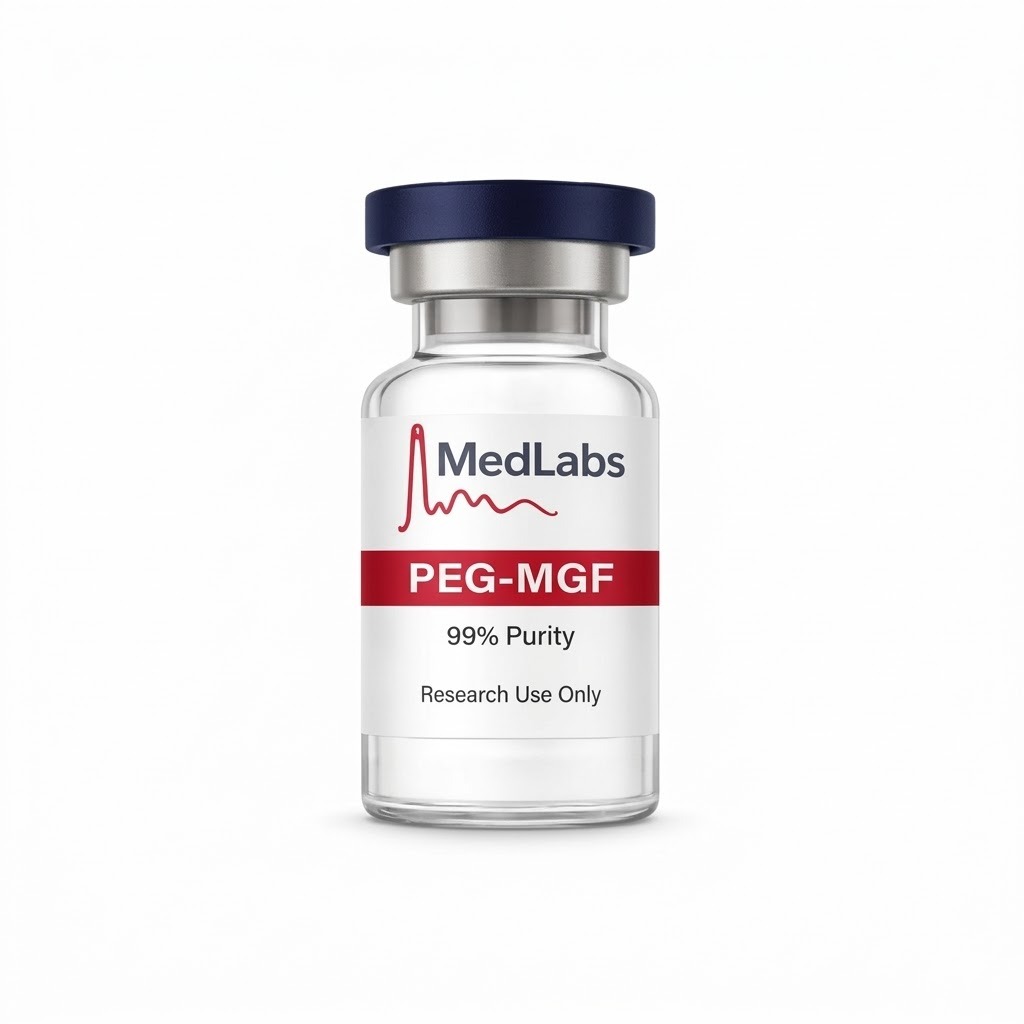
PEG MGF Peptide – Research Grade Pegylated Mechano Growth Factor
Quick Specifications
PEG MGF peptide
- Compound Name: PEG MGF (Pegylated Mechano Growth Factor)
- Molecular Formula: Variable (PEG-conjugated peptide)
- Molecular Weight: ~2,000–5,000+ Da (depending on PEG chain)
- CAS Number: Not standardized
- Purity: ≥98% (HPLC tested)
- Appearance: White to off-white lyophilized powder
- Solubility: Soluble in sterile water or buffered solutions
- Storage: -20°C (lyophilized), 2–8°C (post-reconstitution)
- Half-Life: ~48–72 hours (pegylated form)
- Pack Size: 2mg / 5mg / 10mg vials
Overview
PEG MGF peptide is a synthetic, pegylated derivative of mechano growth factor (MGF), a splice variant of IGF-1. Researchers classify it as a long-acting growth factor analogue designed to extend the biological activity of native MGF through polyethylene glycol (PEG) conjugation.
PEGylation significantly increases peptide stability. While native MGF degrades within minutes, PEG MGF peptide retains activity for several days. This extended half-life supports consistent experimental conditions in muscle regeneration and cellular repair studies.
At MedLabs Peptides, this compound supports controlled laboratory investigations into satellite cell activation, protein synthesis, and tissue responses to mechanical stress. Its structure allows researchers to explore post-injury signaling pathways with improved temporal stability.
Mechanism of Action of PEG MGF Peptide
It interacts with cellular pathways linked to mechanical stress response and tissue repair. After tissue strain or injury, MGF expression increases locally. The pegylated version extends this signaling window, allowing deeper investigation into regenerative pathways.
Researchers studying what does the peptide PEG MGF do focus on its ability to activate muscle satellite cells. These precursor cells proliferate and differentiate into mature muscle fibers. This process supports tissue remodeling and hypertrophy in experimental models.
Unlike full-length IGF-1, PEG MGF shows localized and time-dependent signaling. It influences PI3K/Akt and MAPK pathways, which regulate protein synthesis and cellular growth. These pathways remain central in studies exploring peg mgf peptide dosage and response curves.
Questions such as what are the side effects of MGF typically arise in broader growth factor research. In controlled settings, researchers focus on dose-response relationships, receptor sensitivity, and downstream signaling effects rather than clinical outcomes.
Research Applications
- Cell-based studies on satellite cell activation and proliferation
- Animal model research on muscle repair and regeneration
- Receptor binding and IGF-1 pathway interaction studies
- Comparative peptide research (MGF vs PEG MGF peptide stability)
- Signal transduction analysis (PI3K/Akt, MAPK pathways)
- Protein synthesis and hypertrophy-related investigations
Common Research Questions
What is PEG MGF peptide used for in research?
Researchers use PEG MGF peptide to study muscle regeneration, cellular repair mechanisms, and growth factor signaling pathways.
Does PEG MGF peptide affect muscle growth pathways?
Yes, it influences satellite cell activation and intracellular pathways like PI3K/Akt linked to protein synthesis.
PEG MGF peptide vs native MGF – what is the difference?
PEGylation extends half-life significantly, allowing longer observation of signaling effects compared to rapidly degrading native MGF.
What does the peptide PEG MGF do in experimental models?
It promotes activation and differentiation of precursor cells involved in tissue repair following mechanical stress.
What are the side effects of MGF in research contexts?
Studies typically evaluate cellular response, receptor activity, and dose-dependent effects rather than clinical side effects.
Handling & Storage
- Store lyophilized PEG MGF peptide at -20°C
- After reconstitution, keep at 2–8°C
- Use sterile bacteriostatic water for reconstitution
- Avoid repeated freeze-thaw cycles
- Protect from light and heat exposure
- Gently swirl to dissolve; do not shake
Safety & Compliance
- FOR RESEARCH USE ONLY
- Not for human or veterinary use
- Not intended for diagnostic or therapeutic applications
- Handle only in qualified laboratory environments
- MedLabs Peptides assumes no liability for misuse outside approved research settings
Reviews
There are no reviews yet.